Science Says
Is Social Media Draining Your Productive Energy? (and How to Fix It)

Watch on YouTube: https://youtu.be/B6gel_mSzgk
You open LinkedIn to post one thing for your business. One post. Twenty minutes later you’re three comment sections deep, somebody tagged you in something, you’re answering DMs you never planned to answer… and the post you came to write still isn’t written.
And the advice everyone gives about the stuff you don’t want to see is “just keep scrolling.” Which sounds reasonable, except by the time you scroll past it, your brain has already seen it. You can’t unsee things. And these platforms pay really smart people a LOT of money to figure out how to keep you, specifically you, from looking away.
I’ve been teaching people how to retrain their input since 2021, and it’s how my own feed went from wall-to-wall clickbait to the thing that gets my mornings going. Below are the four steps I use. There’s a free workbook so you can fill it in as you go: grab the Control Your Input Workbook here.
Step 1: Do the vibe check
Open whatever app eats the most of your day and scroll through the next ten posts. For each one, just notice: did it lift you up, do nothing for you, or drain you? Count the drains. That’s your drain score.
I’m bad at math, so I go with ten posts. Three drains out of ten is 30%. Nine out of ten is 90%, and in that case we’ve got some work to do.
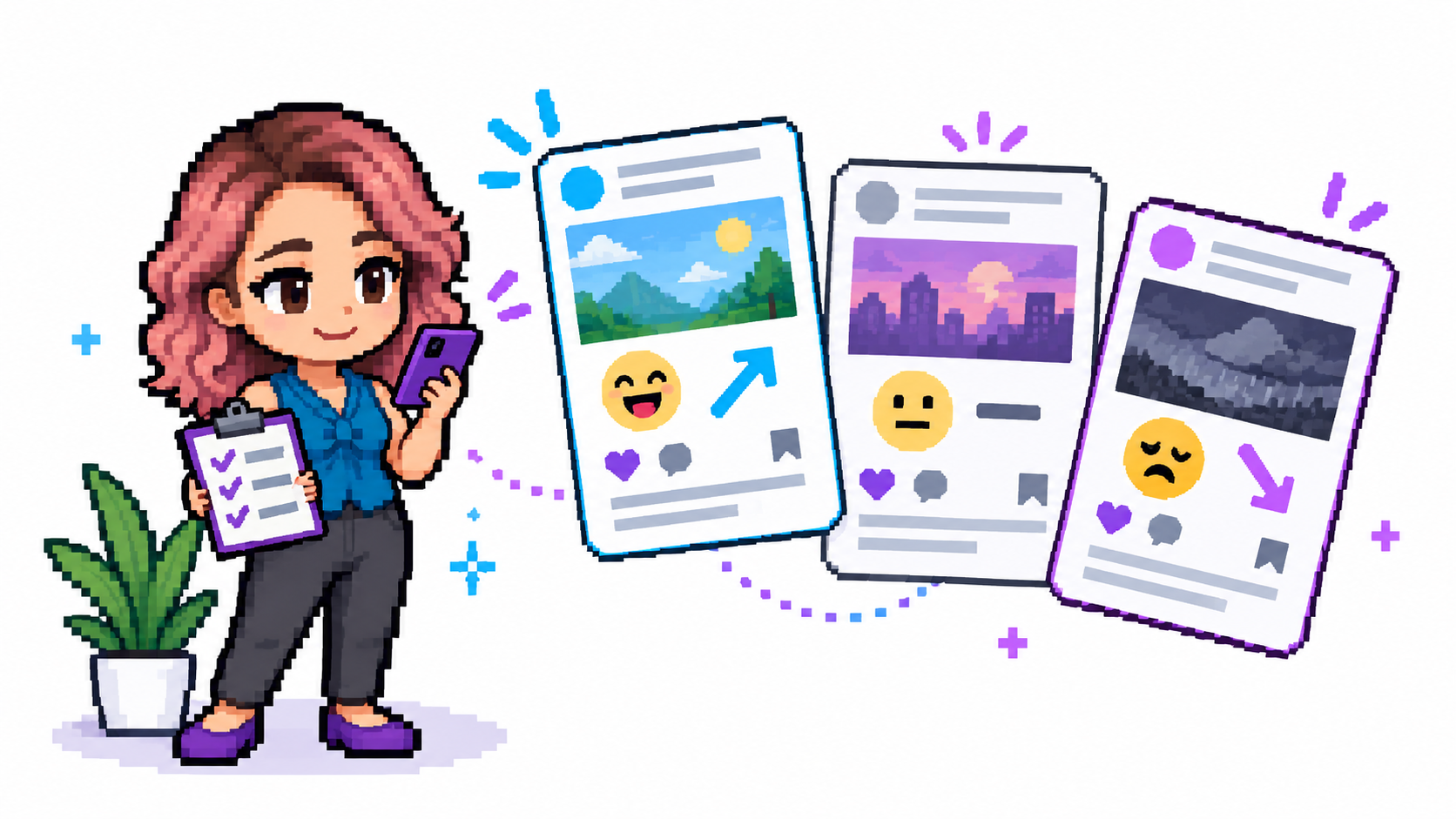
Here’s how mine used to look. I am a total sucker for animal stories. I’d see a headline about a puppy in trouble, and I KNEW it was clickbait, but I still needed to know what happened to the puppy. Just one little click. Before long my feed was almost nothing but people being awful to animals, with a friend’s baby picture every now and then (maybe). And ads, of course. If you’d only seen my feed, you would have thought most of humanity spent their days throwing kittens in trash cans.
And guess who designed that feed… I did, one click at a time.
That’s a problem, because research suggests negative information grabs our attention faster and holds it longer than neutral information. So “just keep scrolling” isn’t how our brains work. And studies have linked doomscrolling to more anxiety and lower wellbeing. (The studies behind both of those are in the science notes at the bottom.)
Hang on to your drain score, because we’re going to get it down.
Step 2: Design your echo chamber (yes, on purpose)
I know, I know. Everyone says social media is an echo chamber and that’s a terrible thing. They’re not completely wrong, but if your clients are on social media, quitting isn’t really an option. It is incredibly difficult to be off all social media and still run a business or, for a lot of us, even do our jobs.
And once we’re on those platforms, our feed is already filtered for us. The platform ranks what we see based on what we’ve clicked, liked, commented on and even lingered over. It doesn’t care whether you clicked because you were inspired or because you were furious. A click is a click. So you’re getting a filtered feed no matter what… you might as well be the one who designs it, on purpose, into something that works with your brain.
Back when I first decided to “fix” my feed, my rule was that it only got things that were motivating, inspiring, or positive. And then I overdid it. I accidentally built an Instagram where the entire world was 100% happy, rich, healthy and crushing it every single day, and it made me feel like garbage. Toxic positivity can be a draining echo chamber too.
And it’s not just me. Research on social media comparisons finds that seeing people who look like they’re doing better than you tends to drag down your mood and self-esteem.
So now my balance is people improving themselves, their lives, their businesses. Real people working on something, including the messy Tuesday parts. I get into why that matters in my post “Choose Your Hard” Is Making You Worse at Hard Things, because whatever your feed shows you starts to feel like normal.

And if you’re thinking “but I need to stay informed,” me too. That’s exactly why I don’t let an app decide when I see the news. I go get it on purpose, when it’s right for me, instead of letting it assault my eyeballs and brain at 6am on a Wednesday.
Your turn: finish this sentence: “My feed only lets in things that…” Then make a second list of what stays out, and where, when, and how you’ll go get it on purpose instead.
Step 3: Clean it and stop feeding it
Now YOU know what you want in there. The platform doesn’t know yet, and it won’t until you tell it.
Settings menus help (ad preferences, muted words, your following list). But the fastest way is to work right in your feed, post by post, because every time you hide something, you’re giving the algorithm feedback about what you do NOT want.
- Ads: when an ad isn’t for you, hit hide. That tells the platform “not for me,” so it should show you less like that. Report the ones that are scams or offensive, and hide the ones that are just not for you.
- People: unfollow or mute without unfriending. You can love your cousin and still not want his rants in your feed every morning.
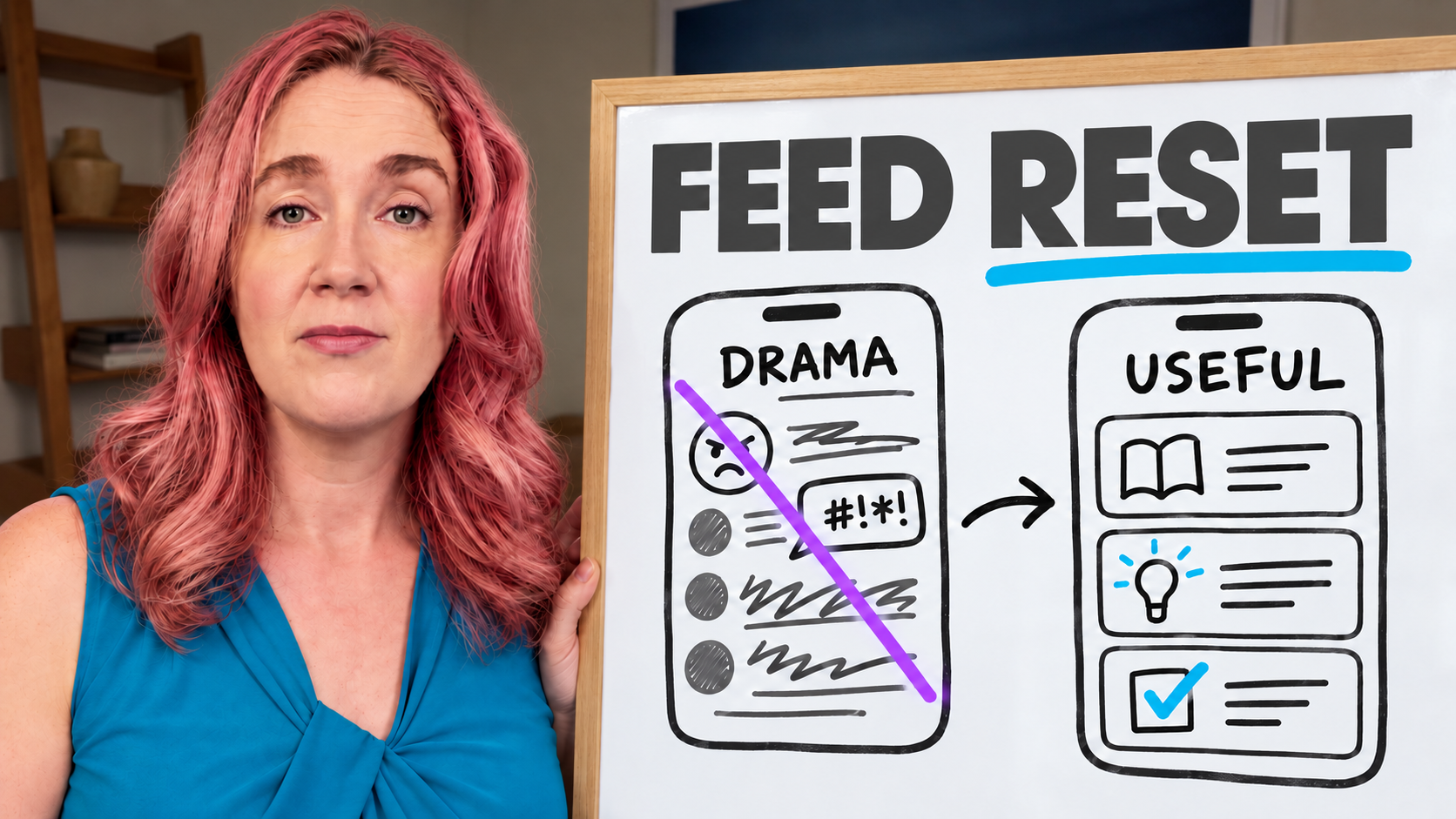
- Topics: hide whole topics wherever the app lets you. I hide everything political, whether I agree with it or not, from friends, groups, pages and ads.
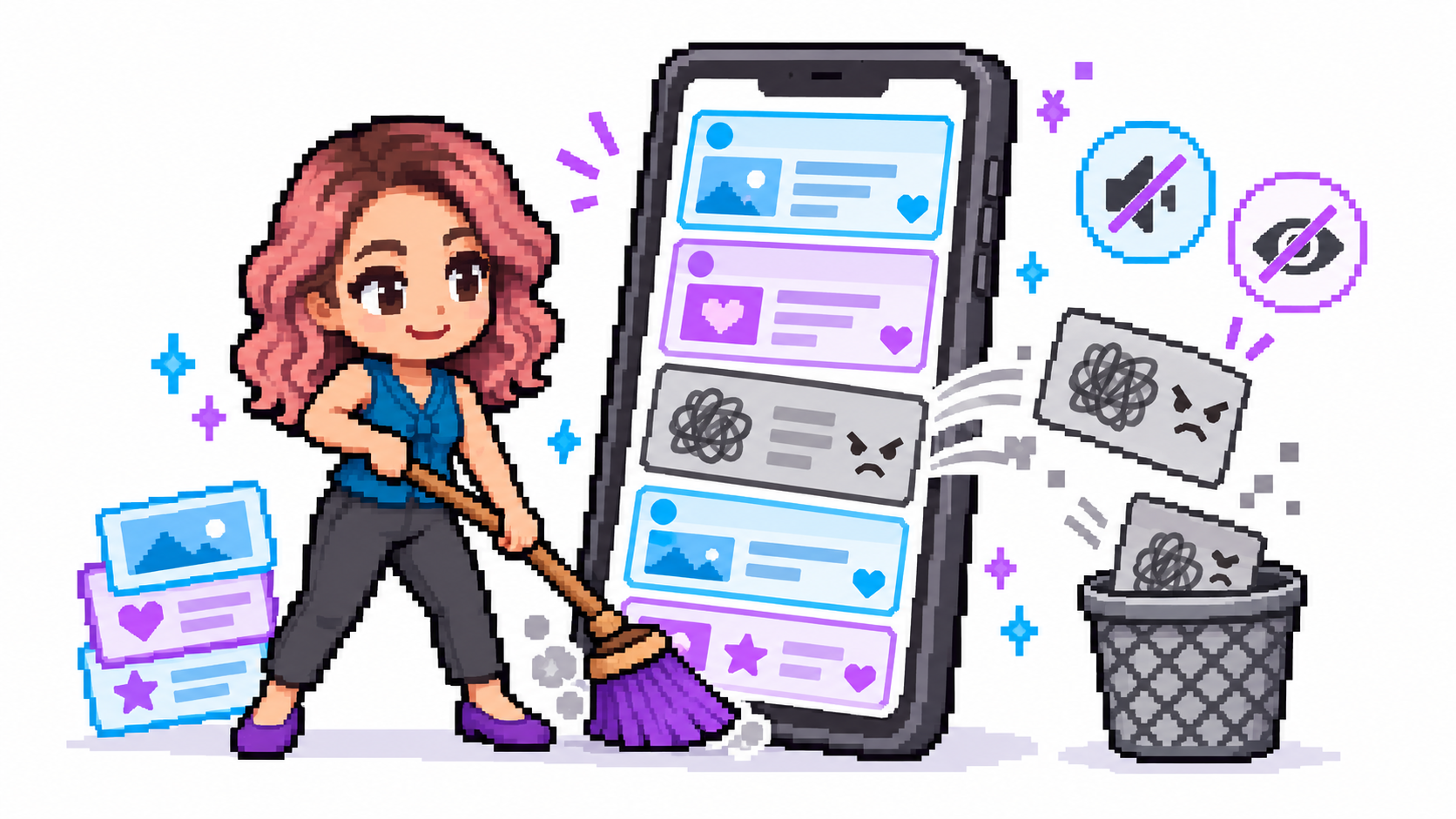
Then comes the stop-feeding-it part. You’re going to see something you can’t resist. You’re human. When that happens, don’t click it in the app. Close the app, open your browser in incognito, and go find the story there. These days you can even screenshot it and send it to an AI tool. You still get to find out what happened to the puppy, but you’re not telling the algorithm to show you ten more “did the puppy get saved” stories. Plus the extra friction means you’ll need to REALLY want to see it.
And if you already fed it, in many cases you can clean that up too. Recently YouTube got me. I clicked on one tiny little influencer drama video because I’d heard about the story and was curious to get the tea. The creator was good, so I got recommended another, then another, and then my recommendations were full of them. I started noticing I had way less energy in the mornings, and it took me a minute to connect it to those videos. So I went into my watch history and deleted every single one, YouTube stopped recommending them, and I was back to my energetic, good-to-go mornings. 😅
That’s my experience, though, and yours may be a little messier. Independent audits of these buttons found they cut down similar recommendations without wiping them out completely (more in the science notes).
Step 4: Schedule your input
So now your feed is clean and you’re done, right? Well… even a perfect feed can still eat your whole workday if you open it every time you’re bored or stuck. Step four is deciding when you consume, what you consume, and when the apps stay closed.
Here’s what that looks like for me. I don’t do ANY social media in the morning. I watch YouTube with my coffee, with autoplay turned off. (And yes, that’s the same YouTube that just got me.) With autoplay off, nothing plays until I pick it. I see a thumbnail and a title, and I decide whether that video gets the next 5 minutes, 8 minutes, or twenty. On Instagram, the whole post is in front of me before I’ve decided anything. So my mornings stay work stuff, rock climbing, and things I want to learn.
I also pick a video that fits the time I actually have. If I’ve got fifteen minutes with my coffee, I pick something around fifteen minutes, or two 7- or 8-minute videos. I decide how much time it gets, instead of getting sucked into the next one, and the next one.
What I refer to as actual social media gets my super short breaks that happen naturally during the workday (if you know what I mean). Outside work hours, I use an app blocker so I’m not even tempted. During work hours I leave social media unblocked, because I do use it for work, and I block it when it doesn’t have a productive job to do. App blockers, and why we reach for our phones in the first place, got their own post: 3 Reasons You Can’t Focus (Most People Only Fix One).
Consuming goes way beyond social media, too. Podcasts, newsletters, webinar after webinar you never act on… it all counts. Yes, including this blog post. My rule of thumb is to aim for about 80% producing and 20% consuming where you can.
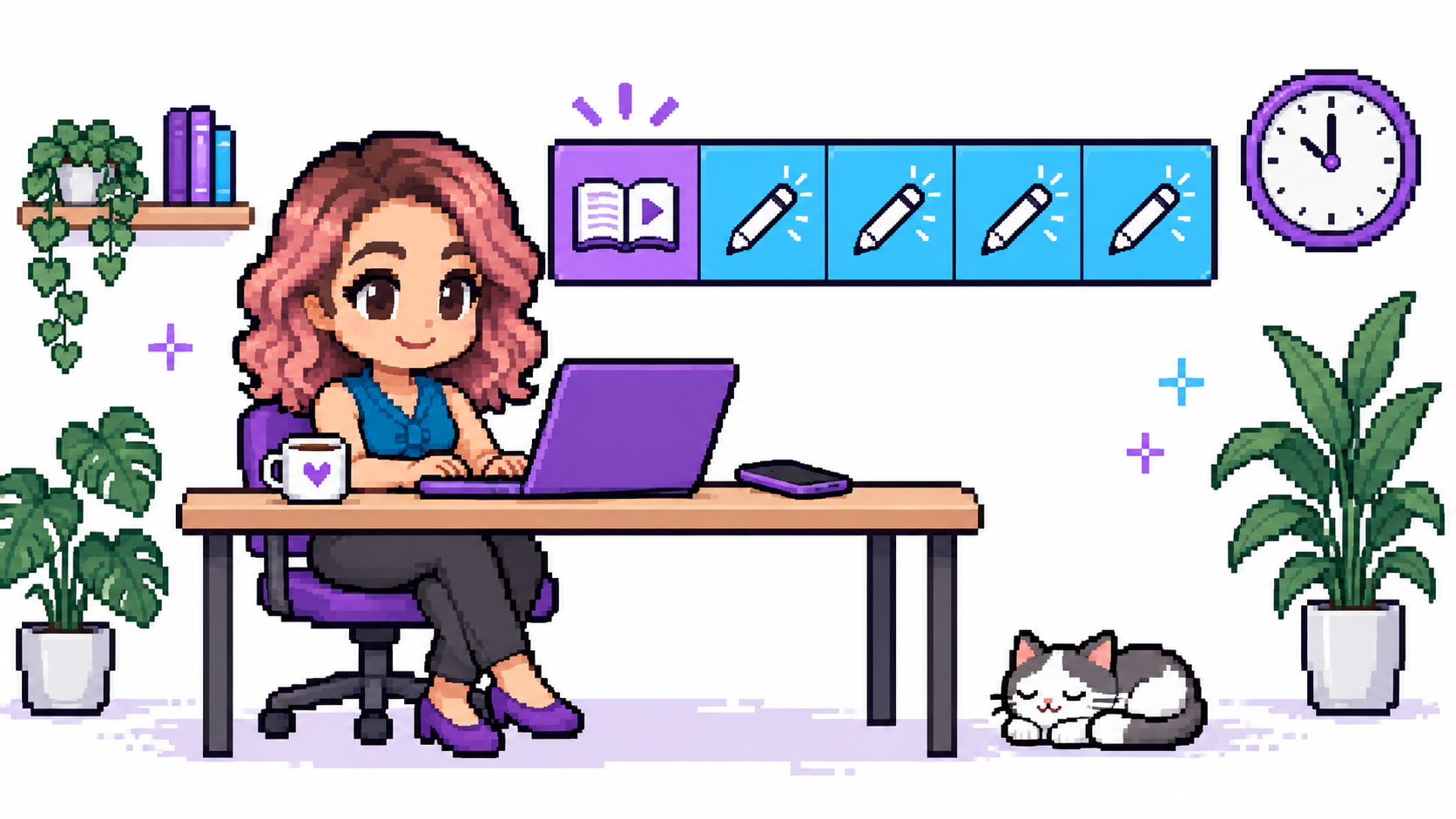
Your turn: write down your consume windows (when, where, and what you’ll watch or read) and your produce windows, where the apps stay closed.
Your feed will be an echo chamber either way
So next time your feed’s draining you: check the vibe, design your echo chamber, clean it, and schedule your input.
When I made my first training on this, I went to grab a screenshot of all those awful kitten headlines to show people, and I couldn’t find a single one. My feed was so clean I had to Google “clickbait” just to get an example. 🙌
Your feed is going to be an echo chamber either way, so you might as well be the one who designs it.
Your next step: grab the free Control Your Input Workbook. It has all four steps, from your vibe check to your consume windows, with space to write your answers. Do your vibe check today, then keep it somewhere handy. The next time you open an app to post one thing and end up three comment sections deep, you’re going to want it.
So, let’s hear it… what was your drain score? Tell me in the comments. I read every single one.
Want more science-backed ways to work WITH your brain? Get the Productivity Stacks newsletter, twice a week.
Science notes
Here’s a closer look at each study behind this post, what it found, and where the evidence has limits.
Negative information grabs our attention
The main study here is an eye-tracking experiment by Castellanos-Chacón and colleagues, published in PLOS ONE in 2026. They tracked where people’s eyes went when looking at images with different emotional content. In their words: “Our findings revealed a sustained attentional bias toward negative stimuli during both early and late processing stages, even in a non-clinical population.”
This is one new study, and it used images on a screen rather than an actual social feed, so think of it as an early finding. It does line up with older work, though. Soroka, Fournier and Nir (2019) measured people’s physical reactions to news across many countries and found stronger reactions to negative news, and Veerapa and colleagues (2020) found negative images held healthy adults’ attention longer. Both are listed in the sources below, along with a 2024 follow-up study that repeated Soroka’s work.
Doomscrolling, anxiety, and wellbeing
Satici and colleagues (2022) built a scale for measuring doomscrolling and looked at how it related to distress and wellbeing. Their finding: “Structural equation modeling indicated that the relationship between doomscrolling and wellbeing indicators were mediated by psychological distress.”
One catch: this kind of research is correlational. It shows doomscrolling and feeling worse tend to go together, but it can’t tell us which comes first. Doomscrolling might drag people down, people who already feel worse might scroll more, or both. Satici’s study also folded anxiety into a combined distress score, so the anxiety link comes from a separate study by an independent research group, Sharma, Lee and Johnson (2022). Taskin and colleagues (2024) add another link to lower wellbeing.
Comparing yourself to people who seem to be doing better
This is the strongest evidence in this post. McComb, Vanman and Tobin (2023) pulled together 48 studies in a meta-analysis (a study of studies) that tested what happens when people see “upward comparison” posts on social media. Their result: “Analyses revealed an overall negative effect of upward social comparison relative to downward comparison and controls on social media users’ self-evaluations and emotions (g = −0.24, p < .001).”
In plain English, g = −0.24 is a small effect. It’s real, but it’s small, so it shows up as a tendency on average. The authors also checked whether missing (unpublished) studies might be inflating the result, and the adjusted estimate was g = −0.18, still negative and significant. Midgley and colleagues (2020) found the same direction in their own studies of social media comparisons and self-esteem.
Autoplay and feeling in control
The research behind my autoplay-off habit comes from Lukoff and colleagues (2021), who studied how YouTube’s design affects people’s sense of agency (in other words, how in control people feel of their own viewing). Their finding: “From a survey of 120 U.S. users, we find that autoplay and recommendations primarily undermine sense of agency, while playlists and search support it.”
This research measured how in control people feel. It didn’t measure minutes watched, so I can’t promise that turning autoplay off will save you a specific amount of time. Schaffner and colleagues (2023) found similar sense-of-control themes in interviews with Netflix users.
Hiding posts, “not interested,” and deleting watch history
Two independent audits have tested how well YouTube’s controls actually work. Liu and colleagues (2024) found that “not interested” removed about 88% of same-topic recommendations from people’s homepages. McCrosky and colleagues (2026) found that even the strongest controls prevented fewer than half of similar recommendations. The two audits measured things in different ways, but together they point the same direction: these buttons reduce what you see, and they don’t eliminate it. My watch-history story is my own experience, and your results may differ.
What we deliberately didn’t cite
We left out Kramer and colleagues’ 2014 Facebook “emotional contagion” study, because the journal (PNAS) published an editorial expression of concern about its ethics. We also left out a 2026 doomscrolling meta-analysis by Li and colleagues, because it’s very new and its own authors rate the certainty of the evidence as very low. And the drain score, the 80/20 producing-to-consuming split, and the four steps themselves come from my coaching work. They’re practical rules of thumb, and no study tested them directly.
Sources
Core sources
- Castellanos-Chacón, A., Arias-Otero, D., Uribe-Jaramillo, V., Leongómez, J. D., & Vásquez-Amézquita, M. (2026). Effects of stimulus emotional content on gaze pattern: An eye-tracking study. PLOS ONE, 21(1), e0341261. https://doi.org/10.1371/journal.pone.0341261
- Satici, S. A., Gocet Tekin, E., Deniz, M. E., & Satici, B. (2022). Doomscrolling Scale: Its association with personality traits, psychological distress, social media use, and wellbeing. Applied Research in Quality of Life, 18(2), 833–847. https://doi.org/10.1007/s11482-022-10110-7
- McComb, C. A., Vanman, E. J., & Tobin, S. J. (2023). A meta-analysis of the effects of social media exposure to upward comparison targets on self-evaluations and emotions. Media Psychology, 26(5), 612–635. https://doi.org/10.1080/15213269.2023.2180647
- Lukoff, K., Lyngs, U., Zade, H., Liao, J. V., Choi, J., Fan, K., Munson, S. A., & Hiniker, A. (2021). How the design of YouTube influences user sense of agency. Proceedings of CHI ’21. https://doi.org/10.1145/3411764.3445467
Supporting research
- Sharma, B., Lee, S. S., & Johnson, B. K. (2022). The dark at the end of the tunnel: Doomscrolling on social media newsfeeds. Technology, Mind, and Behavior, 3(1). https://doi.org/10.1037/tmb0000059
- Taskin, S., et al. (2024). Doomscrolling and mental well-being in social media users: A serial mediation through mindfulness and secondary traumatic stress. Journal of Community Psychology, 52(4). https://doi.org/10.1002/jcop.23111
- Midgley, C., Thai, S., Lockwood, P., Kovacheff, C., & Page-Gould, E. (2020). When every day is a high school reunion: Social media comparisons and self-esteem. Journal of Personality and Social Psychology, 121(2), 285–307. https://doi.org/10.1037/pspi0000336
- Soroka, S., Fournier, P., & Nir, L. (2019). Cross-national evidence of a negativity bias in psychophysiological reactions to news. PNAS, 116(38). https://doi.org/10.1073/pnas.1908369116 (2024 follow-up study: Dubèl et al., https://doi.org/10.17645/mac.7807)
- Veerapa, E., et al. (2020). Attentional bias towards negative stimuli in healthy individuals. Scientific Reports, 10. https://doi.org/10.1038/s41598-020-68490-5
- Schaffner, B., et al. (2023). Don’t let Netflix drive the bus: User’s sense of agency over time and content choice on Netflix. PACM Human-Computer Interaction. https://doi.org/10.1145/3579604
How well feed controls work
- Liu, A., et al. (2024). How to train your YouTube recommender to avoid unwanted videos. Proceedings of ICWSM, 18. https://doi.org/10.1609/icwsm.v18i1.31363
- McCrosky, J., et al. (2026). Does this button work? Investigating YouTube’s ineffective user controls. Proceedings of the ACM Web Conference 2026. https://doi.org/10.1145/3774904.3792183