Science Says
How to Outsource the Work You Hate (Without Hiring Anyone)

What if you could outsource everything in your business that stresses you out, bores you, or that you just do not want to do? And I don’t mean hand it all to AI, and I actually don’t mean hiring anyone either, because “just delegate it” is great advice if you have the money. Most of us don’t start there. I definitely didn’t.
I’m talking about THAT task. You know the one, the one that makes your stomach just drop every time it shows up on your list. You’re not lazy. You run an entire business. You do hard things every single day. But that one task, maybe it’s more than one, keeps just not getting done. And avoiding it isn’t free. It’s always costing you something. Mine was bookkeeping, and it was costing me tens of hours every month, and honestly a lot more than that.
By the end of this post, you’ll have a four-step method that takes your most dreaded task mostly off your plate. No payroll required, and there’s a free worksheet, the Distance Ladder worksheet, that walks you through the whole thing. Because everyone teaches systems as an efficiency thing. But the systems that changed my business were doing a completely different job. They were deciding which version of me had to face the scary thing.
If we haven’t met, hi, I’m Jenae from Productivity Stacks. We’re an evidence-based productivity site for freelancers and small business owners, and we help you work with your brain, not against it. Grab that free worksheet if you just want to jump straight to the action items. I totally get it. But stay with me for the why, because knowing why this works is what makes it stick when the task is really, really uncomfortable.
Why You Keep Avoiding That One Task
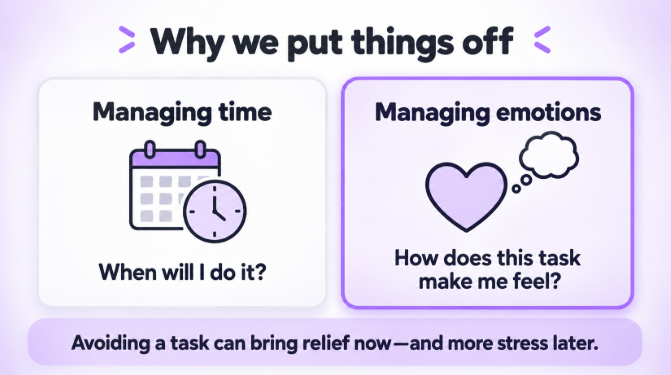
Have you ever thought about why you can handle a genuinely difficult task at 9 AM and then spend three weeks avoiding some 40-minute task that most people would consider basic admin? Well, research suggests that procrastination has a lot less to do with managing time and a lot more to do with managing emotions. We put things off to escape how they make us feel.
And to be honest, it works… sort of, for the moment, at least for present-you. Present-you is like, “I feel better.” But future-you is stuck with the task, and sometimes it’s even MORE stressful now, because it’s been put off.
For me, that task was anything involving money. I have financial trauma, so opening my books never felt like just an admin task to me. It felt like danger. If you’ve seen my post on productivity privilege, you already know this about me. If you haven’t, it’s about why most productivity advice basically assumes that zero of your tasks are scary or difficult. Either way, my brain did what brains do with danger. It kept me away from it. So week after week, I would procrastinate.
And notice what that means. The task itself was never actually all that hard or complicated. It’s not calculus, rocket science, none of that. But for me it was CHARGED. And a charged task behaves differently than a hard one. Most productivity advice just shrugs here and says, “Discipline. We gave you the step-by-step. Just do the thing.” I think we can do better than that.
Outsourcing to Yourself
Enter what I call outsourcing to yourself. You may not be able to pay someone else to face the scary task for you just yet, but you can stop making the scared version of you face it alone.
Calm-you, on a random Tuesday when nothing’s triggering, builds the system: the steps, the templates, the folders. Then when the task comes up, scared-you doesn’t have to decide or feel her way through anything. She just follows the steps that calm-you already wrote. Every decision you remove for her is distance, and distance is what makes that task doable.
I learned this accidentally, so let me tell you a little story. It’s short, don’t worry. Back in my freelance days, I used to get lowball offers. Really, really cheap rates. And I’ll be honest, I was offended. Really offended. I would stew, I would draft angry replies, I would try super hard not to send them. And one day I decided I can’t deal with this anymore, but I also can’t control these people sending me these offers. So I drafted a handful of polite decline templates.
After that, a lowball offer came in, it took me two seconds. Copy, paste, send, move on with my life. I only half-read the email as soon as I saw what it was. Those templates did save me time. But the real win was that I never had to just stand in that icky feeling again and stew and let it ruin my entire day.
The Distance Ladder
So how do you actually build this for YOUR scary task? Remember the rule: every decision you remove is distance, and distance is what makes the task doable. So we’re going to stack that distance deliberately, one layer at a time, which is why I call this the Distance Ladder. Four rungs, each putting a little more space between you and the thing.
Pick one dreaded task. Just one this time around. But before you climb anything, let calm-you ask one question: does every step of this task actually need to happen? Back in my invoicing days, I reached out to a client and asked, “Hey, can I send just one combined invoice every two weeks instead of one invoice per project?” Because back then I was invoicing so many small projects, it was SO many invoices. They loved it. And just like that, dozens of invoices basically stopped existing, because I was just adding everything to one combined invoice. Anything you can eliminate is distance you get for free.
Okay. Now we climb these rungs, in order.
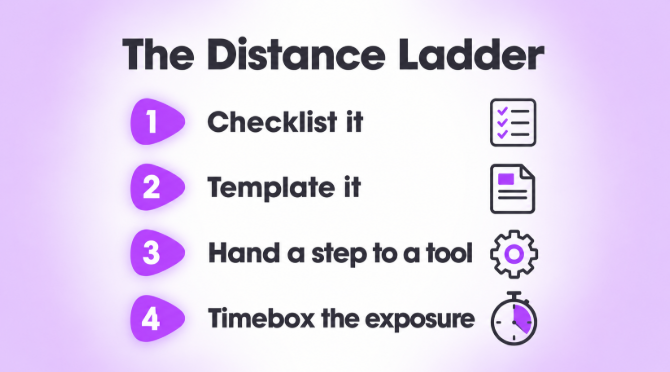
Rung one: checklist it. Calm-you writes down every single step, and I mean embarrassingly small steps. Open the folder, click the icon, et cetera. When I finally set this up for bookkeeping, I ended up with a dedicated email address just for purchase orders, payables, and receivables, because my list of steps was so long I was like, no WONDER I’m getting triggered so much. I was spending so much time making all these decisions. No more digging through my inbox hunting for a purchase order while my anxiety climbed with every single search. A checklist means scared-you is not deciding things, just executing. Boom, boom, boom.
Rung two: template it. Kill every blank page inside the task. Just like those pre-written templates for the lowball offers: pre-written emails, saved replies, pre-formatted spreadsheets, anything like that. If a step starts with “figure out what to say,” that step belongs to calm-you, in advance, because that step is going to trigger all that decision-making.
Rung three: hand a step to a tool… and yes, that includes AI. I know, I know. I said this was not an AI post, and I meant it. It’s not. AI is just a tool, and you can use a different tool. The difference is who’s in charge. I recently had a client who was stuck on writing this really difficult email. Lots of emotional friction, like my money-related tasks. I told her, “Just have AI write the first draft.” You’re still going to customize it, obviously. But now you’re editing from the outside instead of writing from the inside, inside that scary zone with all those decisions. You can even write in that first draft exactly what you think and let the AI calm it back down and make it professional. All of that is creating distance. Schedulers, autofill, any of these kinds of tools can help. If you can let a tool stand between you and a step, let it.
Rung four: timebox the exposure. Put a container around it with a hard stop. Mine was an invoicing block: just that dedicated inbox open, everything I needed in one place, knock them out, done. The hard stop matters because you’re teaching your brain that you’re going to VISIT the scary zone, but you’re not going to move in. You don’t live there, and it’s not going to visit you unexpectedly.
Now, if this ladder feels almost too simple to work, here’s the science. Research on implementation intentions, which is basically deciding in advance exactly when and how you’re going to do something, consistently finds that it improves follow-through, because the moment of action stops requiring a fresh decision. And that’s the same principle behind every rung you just built.
The worksheet walks you through all of it: pick your task, run the eliminate question, then climb the rungs one at a time with a prompt for each.
Rung Five: Team
And I’m going to be honest with you, because that’s what we do here. Even with my system so dialed that pretty much anybody could have run it, bookkeeping still took me hours every month, and I was doing a mediocre job tracking expenses. So when I finally could afford a bookkeeper, it was a MASSIVE upgrade. That’s not to say the system doesn’t work. It does, and it was a huge help. But adding a whole person as a level between me and the task was even better.
That brings me to rung five: team. And here’s the part most people leave out, especially if you’re getting frustrated with me for even mentioning hiring in a post about outsourcing to yourself. When that day came for me, the handoff was SO easy, because the checklist from rung one, the whole system, WAS the training doc. I could hand it off without spending a huge amount of time, energy, and bandwidth onboarding her.
So you can outsource the stuff you hate, the stuff that bores you, the stuff you just don’t want to do. Just not to who everybody might assume. It turns out the person you hand it to can be a calmer version of you. And that stomach-drop task from the start of this post? You’re not broken, and there’s a way through that doesn’t run on willpower. Build some distance this week, one rung at a time. A good system holds the scary thing so you don’t have to.
So let’s hear it in the comments: what’s YOUR bookkeeping? Name the task. I read every single one, and your answer might help someone else pick theirs.
If you found this helpful, sign up for our newsletter here to get more content like this delivered straight to your inbox.
Science Notes
The content we produce leans on published research, so it’s only fair to show you the cracks too. No study is perfect, and pretending otherwise is exactly how productivity advice gets oversold. Here’s what the studies behind this video can tell us, and where the evidence stops. Both findings reflect the accepted body of research, and neither is an outlier study.
On procrastination as mood repair (Sirois & Pychyl, 2013). A conceptual review: the authors interpret the existing research, and nothing new gets measured in a review, so this is a well-argued framework with a lot of evidence behind it, and you should hold it a little more loosely than a hard measurement. The framework is the paper’s own: procrastination prioritizes short-term mood repair, and the consequences typically land on the future self. “Present-you gets the relief, and future-you is stuck with the task” is that finding in plain words. One honest crack: the paper reasons its way to “relief now, repeat later” from the wider literature. It didn’t run a reinforcement experiment. What fills that gap: experimental work by Tice and colleagues (2001) showing that when people are distressed, mood repair wins out over self-control, plus two randomized trials where training people in emotion-regulation skills reduced their procrastination. So the mechanism has support well beyond one paper’s argument.
On implementation intentions (Gollwitzer & Sheeran, 2006). A meta-analysis of 94 independent tests, more than 8,000 participants, medium-to-large effect (d = .65) on goal attainment. In this field, that’s about as solid as evidence gets. Honest cracks. 79 of those 94 tests used university students, and zero used business owners, so keep that in mind (the 2024 update below helps here). The studies measured whether people started specific actions and protected them from derailment, so “follow-through” is a fair everyday name for it. It also doesn’t work everywhere: at least one study, in a multimedia-learning context, found no effect. And one for anyone who counts table rows: the paper’s summary table lists 96 entries because two studies report split samples. The paper itself says 94 independent tests, so that’s the number we use.
A note on the research. Since we’re being thorough (it’s kind of our thing): the Gollwitzer and Sheeran meta-analysis I cite in the video is from 2006, so I want you to know the science didn’t stop there. In 2024, Sheeran, Listrom, and Gollwitzer published a much bigger update… 642 independent tests this time… and the core finding held up. Deciding in advance when and how you’ll do something reliably improves follow-through, across all kinds of plans, including the two kinds the Distance Ladder leans on: plans tied to a time and place (that’s your timebox) and plans tied to a point in a task (that’s your checklist). And this update comes with a practical bonus. The 2024 paper found that not all plans are created equal. Plans phrased as a simple schedule work. Plans phrased as an if-then… “when X happens, I will do Y”… work even better. So if you want to squeeze more out of your ladder, phrase your rungs that way. Not “invoicing block on Friday” but “when Friday at 9 AM arrives, I will open the invoicing inbox and start at the top.” Same rung, stronger wiring. Your brain treats that little “when… I will” as a trigger it can fire on autopilot, and autopilot is exactly what we want scared-you running on.
Sources
- Sirois, F. M., & Pychyl, T. A. (2013). Procrastination and the priority of short-term mood regulation: Consequences for future self. Social and Personality Psychology Compass, 7(2), 115–127. https://doi.org/10.1111/spc3.12011
- Gollwitzer, P. M., & Sheeran, P. (2006). Implementation intentions and goal achievement: A meta-analysis of effects and processes. Advances in Experimental Social Psychology, 38, 69–119. https://doi.org/10.1016/S0065-2601(06)38002-1
- Sheeran, P., Listrom, O., & Gollwitzer, P. M. (2024). The when and how of planning: Meta-analysis of the scope and components of implementation intentions in 642 tests. European Review of Social Psychology. https://doi.org/10.1080/10463283.2024.2334563