Science Says
How to Get Back on Track WITHOUT Starting Over
Bad week or real pattern? Four questions help you decide whether to scale back for now or make lasting room for something, so you can get back on track without rebuilding your whole schedule.

You’re trying to get back on track, but you’re not sure how much needs to change. Maybe you need to give yourself a lighter week. Or maybe you’ve BEEN giving yourself a lighter week, and the stuff you put off is still waiting. And now you’re thinking, “Here I go again.”
A rough week can make a whole new schedule look VERY appealing. Before you redo everything, it helps to figure out what you’re actually dealing with: a temporary disruption, or something you’ll need to keep making room for. It’s not always obvious which is which… or how to handle each one.
So I use four questions. I call it the Acute-or-Chronic Test. Acute means temporary; it has an end. Chronic means it keeps coming back, or it isn’t going away. The test helps you decide what to scale back for now and what might need a more lasting adjustment.
There’s a free Acute-or-Chronic worksheet that walks you through all four questions, what to do with your answers, and space to pick your one adjustment. Grab it here and fill it in as you read.
The morning I couldn’t answer my own test
When I rushed my cat to the ER one morning, I didn’t know how much of my schedule her care would eventually need. Plus there’s the emotional bandwidth. I was terrified. But… maybe this was acute and she’d be better soon.
That’s the tricky part. In the moment, you often can’t tell. So keep one thing that’s been throwing you off in mind as you go through these questions.
Question 1: How often has this happened?
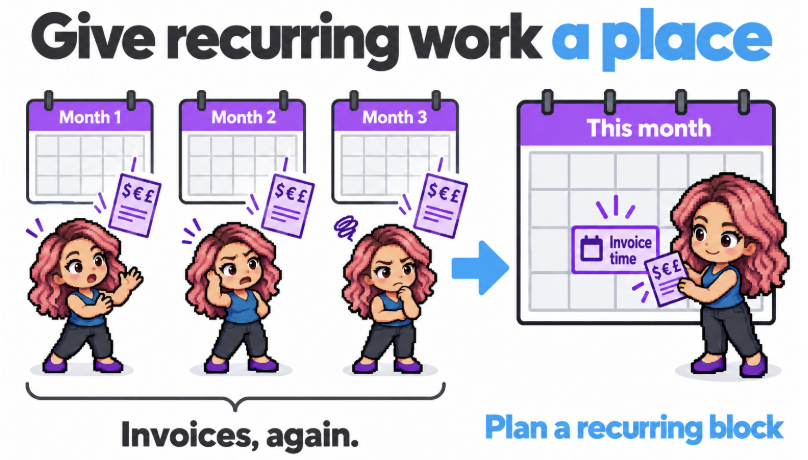
Start with one specific thing. “My whole week was terrible” is understandable, but it’s hard to make a useful change from there. “I spent Friday chasing invoices again” gives you something to work with.
Then look back at your calendar or task list and check how often it’s happened. Maybe you’d describe invoicing as a one-time scramble, then look back and find you’ve been doing it every month. At that point, it deserves a recurring block.
You don’t need a particular number before you’re allowed to change something. You’re looking for enough information to judge whether this was unusual or whether it keeps happening.
Question 2: Does it start the same way?
Look at what was happening BEFORE things went off track. Maybe your week goes sideways whenever one particular client sends revisions. Or you keep planning a full workday after traveling, then spend half of it recovering and looking for your phone charger.
The details tell you what to adjust. You can leave room for revisions, or plan a lighter day after travel.
But sometimes the causes are different every time. Someone gets sick, something breaks, an appointment runs long. Just recently I got my eyes dilated at the doctor and didn’t realize that would happen, so I couldn’t see for the rest of the workday. Not exactly something I could have planned around.
You may not be able to predict the specific interruption. You can still notice whether your calendar only works when NOTHING interrupts it… only when everything is going swimmingly. A schedule that needs a completely uneventful week may need a little adjustment.
Question 3: Is there an end in sight?
Some disruptions have a fairly clear ending. You’re away for a few days, or you’re finishing a project that’s temporarily taking more time than usual. Other responsibilities are going to be part of your life for a while.
And “things should calm down soon” needs a little examination. If you know what’s ending and when, great. If you’ve been saying it since March… I’d take another look.
A lot of us get stuck in a neverending loop of “when things calm down,” except before thing 1 calms down, thing 2 is already ramping up. This is especially common when you run a business, because something is almost always pushing: you pushing a project forward, a client, a team member… something. So be honest with yourself about whether the disruption is the temporary part, or the calm is.
With my cat, I couldn’t answer this one at first. I didn’t know whether we were dealing with a one-time scare or something that would need ongoing care. You may be waiting for information, too. Make a plan for what you know now, and come back to it when you know more. It’s always fine to be wrong. We’re human.
Question 4: Would you be surprised if it happened again?
Imagine this happening again next month. Would you be surprised? Or would you be frustrated, but also recognize it immediately?
Maybe you already know that after a packed weekend of fun with friends, you’re unlikely to be at 100% at 9 AM Monday. And yet every Monday gets the same ambitious to-do list. I call this optimistic planning, and most of us could stand to cure ourselves of it… easier said than done. 😅 You could move your Monday to-do list to another day, make it shorter, or look at how much you’re packing into the weekend.
One caution: being able to predict something doesn’t automatically make it an ongoing problem. A trip can be temporary AND predictable.
Now put your answers together
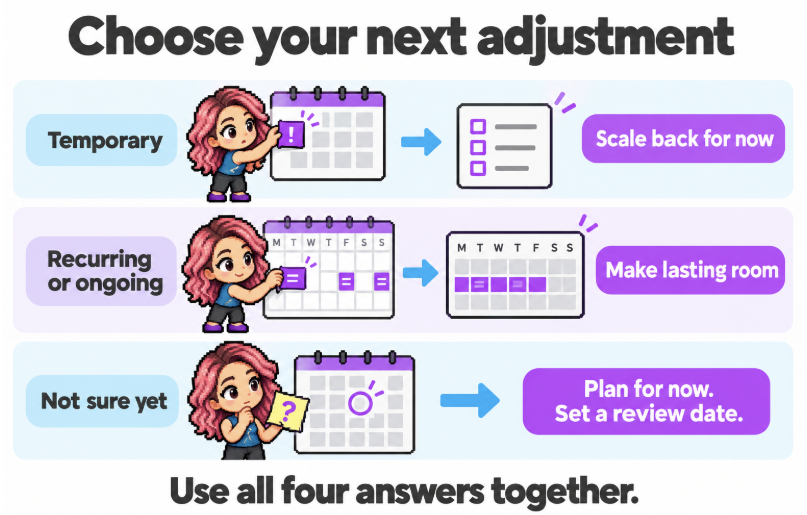
- If it keeps happening and there’s no end in sight, treat it as chronic.
- If it’s new, or it has an end date, treat it as acute.
- If you don’t know yet, treat it as acute for now and pick a date to check again… and maybe again… and again.
Keep checking in so you catch acute turning into chronic before it takes over.
If it’s acute: reduce what you’re asking of yourself
If your schedule was working before a temporary disruption, keep it, and lower what you expect to get done while you deal with it. That’s what I did during my cat’s emergency. I kept my existing system and scaled back the ER day plus the following day.
Scaling back means two things: your to-do list and your routines.
Your to-do list. Look at what truly needs attention, what can wait, and who needs an updated deadline. On some days, the essential task might be sending the message that says you need more time.
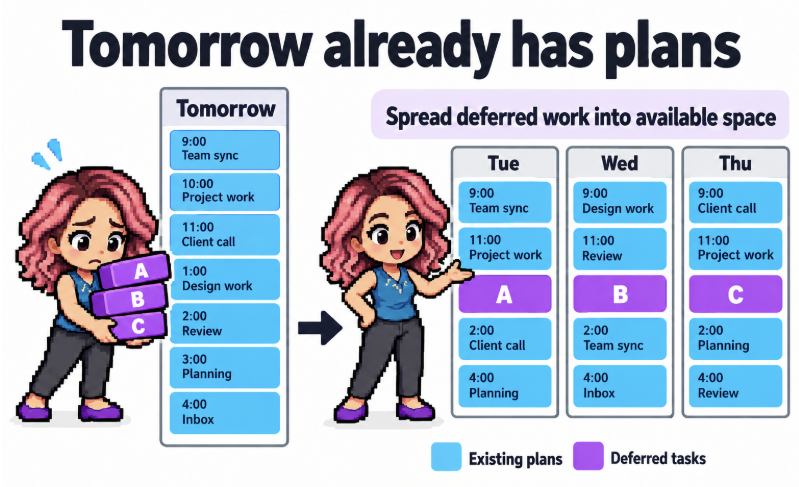
And be careful about moving everything you missed onto tomorrow. Chances are, tomorrow already had plans. This is where a clear system for your calendar and to-do list really helps, so you can sprinkle what you’re putting off across the next few days instead of forcing it all into one.
Your routines. Try not to skip them completely. Where possible, shrink each one to its smallest size, in time or in bandwidth, so you keep what I call the “bucket,” the space that thing takes up in your brain, life, and business. That way you don’t have to build it from zero when things calm down. You just expand it.
And if a day gets skipped completely anyway, don’t worry. Research suggests a single missed day isn’t sending you back to the beginning. (More on that study in the science notes below.)
So when you have room again, you’re not starting over. Go back to the parts of your routine that were working and expand them back up. Just don’t let “skip it for now” turn into “skip it forever.”
If it’s chronic: make room for it
Eventually, my cat’s diagnosis came back, and I knew she would need extensive medication every morning, likely for the rest of her life.
So I timed how long the medication took and created a system for it. Mornings are my best work hours, so I also started booking her vet appointments in the afternoons whenever I could. That gave me a much more realistic picture of the time I actually had for work. It also helped create some distance, which lowered the emotional bandwidth of caring for her. (I walk through that full system, the distance ladder, in How to Outsource the Work You Hate (Without Hiring Anyone).)
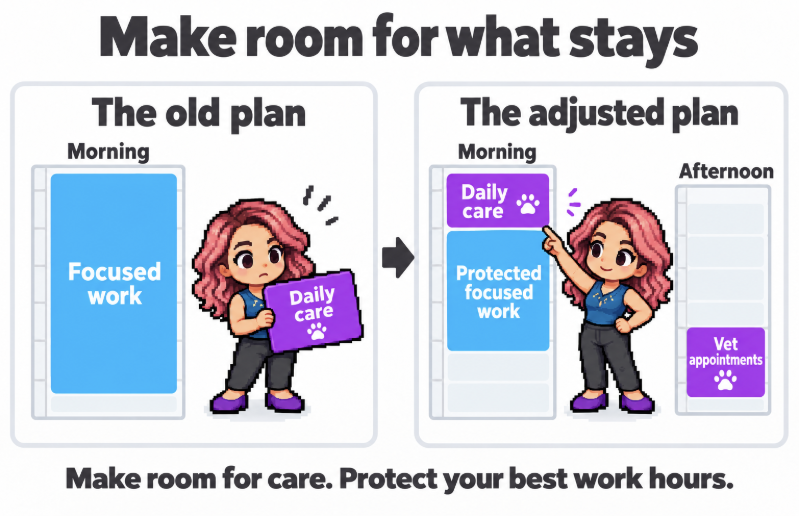
It’s easy to leave your old schedule in place and keep trying to squeeze a new responsibility into it. Especially when you liked your old schedule. Perfectly reasonable to want it back. But if something now takes part of your morning, you need to decide what happens to the work you used to do then.
Pick one recurring problem and get specific about what it costs you. Include recovery time if that’s part of it. Then choose one adjustment you can try before it happens again, and check whether it helped.
If several areas of your life have changed, you may need a broader reset. You can still begin with the part that’s causing the most difficulty right now.
Before you rebuild everything
Ask the four questions:
- How often has this happened?
- Does it start the same way?
- Is there an end in sight?
- Would you be surprised if it happened again?
And if you’re still waiting to find out what you’re dealing with, come back to your answers later. I couldn’t have planned my cat’s ongoing care on the morning we went to the ER. I could scale back that day and make the next decision when I had more information.
Your next step: grab the free Acute-or-Chronic worksheet. It has all four questions, what to do with your answers, and space to pick your one adjustment. Run one thing that’s been throwing you off through it today, then keep it somewhere handy. The next time a week goes sideways, you’ll want it BEFORE you redo your whole schedule.
What’s something you’re trying to make room for right now? Tell me in the comments, and let’s chat. 😊
If you found this helpful, sign up for our newsletter here to get more content like this delivered straight to your inbox.
Science notes
A single missed day. In Lally and colleagues’ 2010 study, 96 volunteers (mostly postgraduate students, average age 27) each picked one healthy eating, drinking, or exercise behavior and tried to do it daily in the same situation for 12 weeks, rating how automatic it felt as they went. The researchers looked at 140 times someone skipped a day right after doing the behavior for three days in a row. Automaticity dipped a little the next day, and the authors concluded that “there were no longer-term costs associated with a single omission.”
A few things worth knowing about this study. It’s one study, of simple health habits, in a fairly young student sample. Running a business is a lot more complicated than drinking a bottle of water with lunch (one of the study’s actual examples). The study also looked at one fully skipped day and didn’t test scaled-back versions of a routine, so the “shrink it instead of skipping it” advice above comes from my coaching experience. And the authors themselves point out that missing a whole week of a behavior is a different story from missing a single day.
How long habits take. In the same study, the time it took people to reach their personal plateau of automaticity ranged from 18 to 254 days, which is a good reminder that there’s no magic number of days, and that one off day along the way isn’t the end of the road.
Sources
- Lally, P., van Jaarsveld, C. H. M., Potts, H. W. W., & Wardle, J. (2010). How are habits formed: Modelling habit formation in the real world. European Journal of Social Psychology, 40, 998–1009. https://doi.org/10.1002/ejsp.674