
Science Says
Stop Tracking Your Goals (Track This Instead)
Learn how to split output goals into checkable actions, give your strategy a fair trial, and use the results to decide what to change.

You posted every single day for a month, and the subscriber count barely moved. Or maybe your version is 50 pitches and two polite “no, thank yous.” You put in the effort. The numbers basically shrugged at you.
Now you’re lying awake trying to figure out whether the strategy is broken, you’re broken, or business is broken. Which thing is it?
That’s a rough place to make a decision about your entire plan. And if you let every disappointing number have a vote, a strategy can get thrown out before it’s had much of a chance.
I use what I call the goal experiment: split it, run it, read it. Three steps to give yourself something you can check off along the way, give the strategy a fair trial, and decide what to change when you have enough information to make that decision.
If we haven’t met, hi, I’m Jenae from Productivity Stacks. We help freelancers and small business owners work with their brains. There’s a free Goal Experiment worksheet that walks you through all three steps, so grab that if you want to skip straight to the action items. I get it, me too. And today, we’re fixing the scoreboard.
Step one: Split it
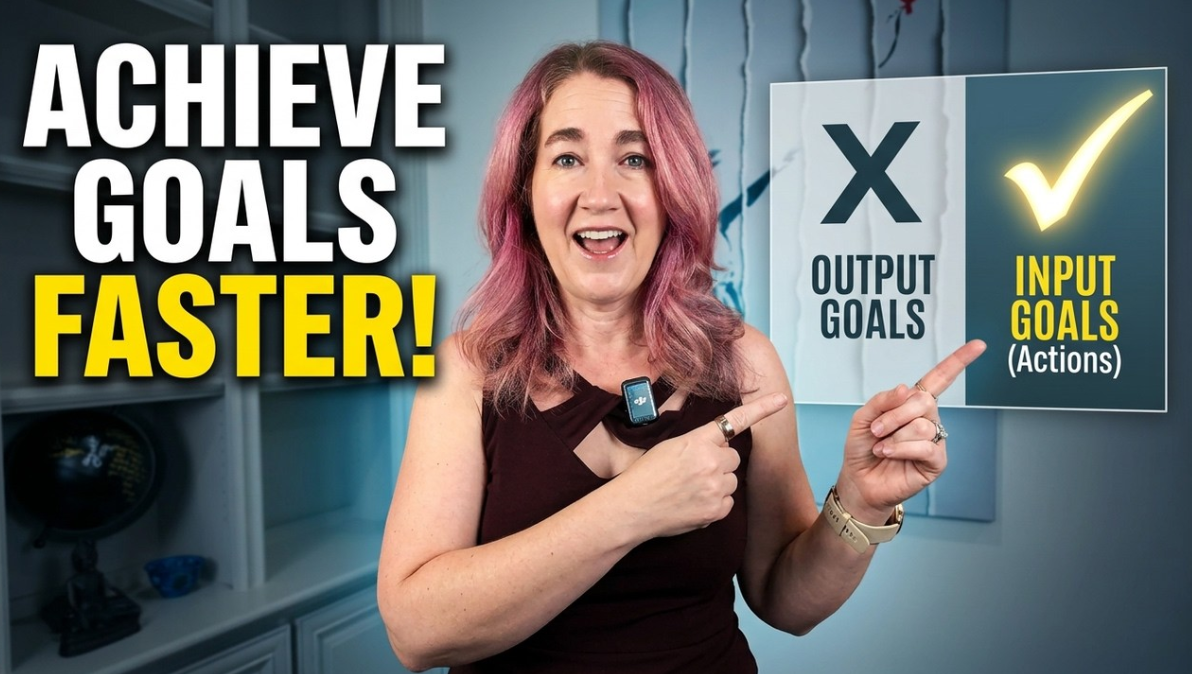
“Land three clients.” “Hit 1,000 subscribers.” Those are output goals. They’re the results you want, but you can’t sit down on a random Tuesday and just complete them.
You can send the pitches. You can publish the video. You can follow up with someone who asked about your services. Those are input goals, the actions you can take toward the result.
Here’s a quick test: can you complete the action yourself, or does getting the result require somebody else to say yes? A client, a viewer, an inbox, an algorithm… there are a lot of other people and systems involved in an output goal. None of them promised to cooperate with your Tuesday to-do list.
Take one output goal and write one to three input goals underneath it. Make each input specific enough that you know when you’ve done it. “Work on marketing” is going to be a very slippery check mark. “Send five pitches to businesses that fit my service” gives you something you can finish.
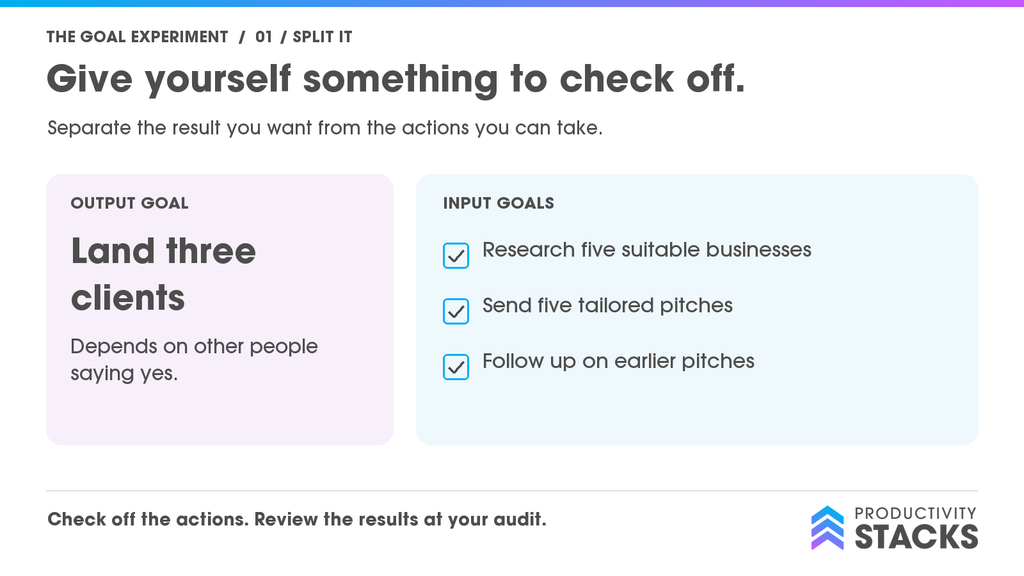
Then put those inputs somewhere you can physically record your progress. Paper, a spreadsheet, a tracker you already use. The worksheet has a page set up for it if you’d rather not build one. You don’t need to spend the afternoon auditioning new apps for the role. 😊
A review of 138 experiments found that prompting people to monitor their progress made them more likely to reach their goals. The effect was larger when people physically recorded that progress compared with not recording it.
And there’s another reason I like giving those check marks some attention. Research suggests that progress toward a goal is tied more closely to well-being than attaining the goal, though attainment is linked to well-being too. Finishing still counts! You just don’t have to save all your credit for the finish line.
To me, that check mark is daily fuel.
Give big inputs some goalposts
One of my input goals right now is to make 100 YouTube videos. It’s an action I can work toward, but that last check mark could be months away. That’s a long time to stare at an empty box.
So I give it goalposts. Video 10, video 25, video 50. Maybe yours starts at video ONE. Celebrate the ones you pass while you keep working toward the bigger input.
Now you have something to check off daily, weekly, or whenever the action fits your schedule. The big inputs have milestones. And the output gets an appointment.
Step two: Run it
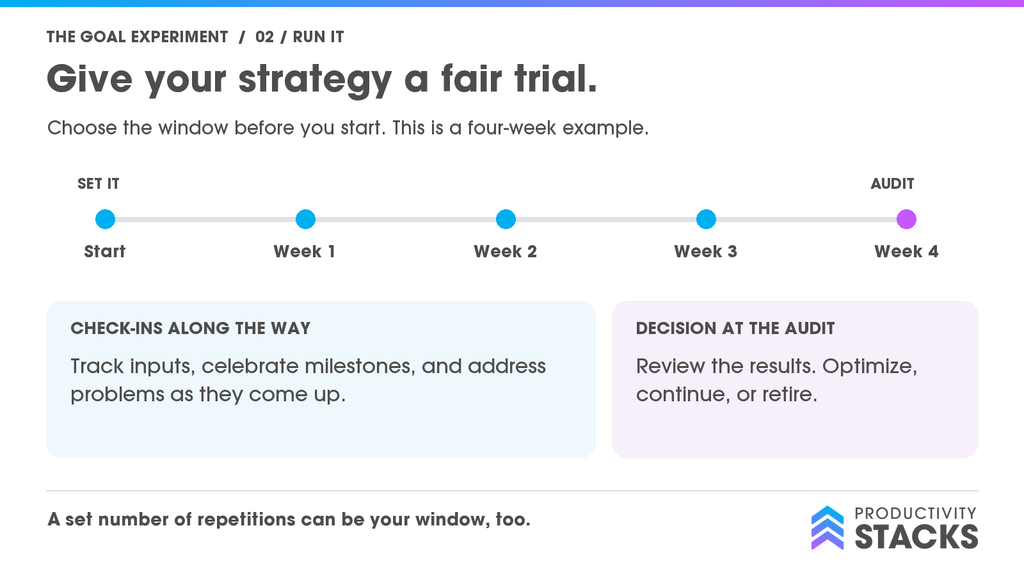
Before you start, decide how much of a trial you’re giving the strategy. Maybe that’s four weeks or six weeks. Maybe it’s a set number of repetitions, like 100 pitches or 100 videos. Pick a window that fits what you’re testing, and set the finish point in advance.
For a time-based experiment, put the audit date on your calendar. For a volume-based experiment, write down the number of repetitions that will trigger the audit. That’s when you’ll decide whether to continue, adjust, or stop.
I call this the runway rule. You’re giving the strategy some room to work before a disappointing result gets to call the whole thing off.
Check-ins are allowed. Encouraged, even. Look at the numbers on Fridays if that works for you. Celebrate a milestone, make sure the pitches are getting sent, and catch anything that’s obviously on fire. You don’t have to keep pouring time or money into a serious problem just because there’s a date on the calendar.
But a check-in and an audit do different jobs. A check-in helps you watch what’s happening. The audit is where you make the bigger decision about the experiment.
A flat subscriber count on Tuesday might feel like a verdict. It’s still only Tuesday’s number. Your pitch might have arrived right as a potential client left for vacation. Your latest video might need more time to find its audience.
Without a window, it’s easy to post daily for a week, get disappointed, switch to carousels, get disappointed again, and then abandon the whole platform for cold email. Pretty soon you’ve tried several things without giving yourself much information about any of them. Business strategy starts to look a lot like channel surfing.
The window gives you permission to let the experiment run.
When check marks were all I had
I ran my longest version of this rule before I even had a name for it. When I was building my coaching business, translation was paying the bills. Coaching was crickets. No audience, no revenue, and very little to point to.
For months, those check marks were the proof that I was building anything at all. If I’d let the outputs judge me every day, I would have quit before I gave it a chance.
That’s why I want the input to get some credit NOW. You can keep track of the result without asking it to reassure you after every single action.
Step three: Read it
On audit day, the output number finally gets its appointment. Bring the numbers, along with what it took to get them.
Let’s say you tried cold DMs on LinkedIn. You sent 100 messages, got 10 replies, and landed two clients. This is an example, not a benchmark you’re supposed to hit.
It’s easy to look at that and think, “All those messages for two clients? I’m terrible at this.” But there are more useful things to ask of those numbers. You now know what those messages produced, and you can look at each stage separately.
If you got few or no replies, the message or the targeting could be worth examining. If people replied but the conversations didn’t turn into clients, look more closely at the offer, the fit, or how those conversations went. The numbers give you a place to investigate. They don’t diagnose the whole business for you.
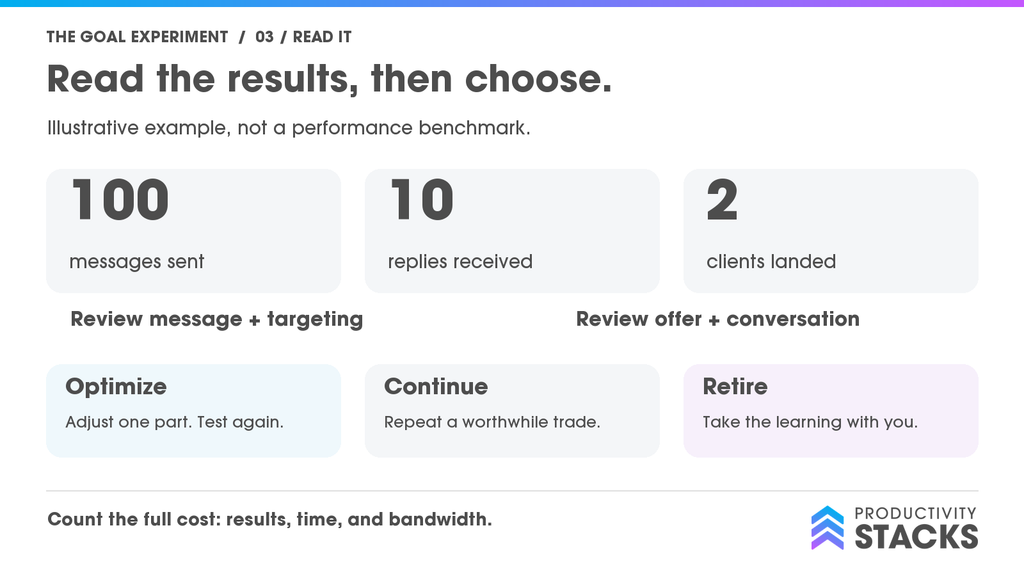
Then choose one of three next steps:
- Optimize. Change one part of the process and run another experiment. If the replies were the problem, start there instead of rebuilding everything.
- Continue. Two clients for that amount of effort might be a trade you’d happily repeat. Keep going with another defined window.
- Retire. Maybe the return is too small for what the strategy costs you. Take what you learned into your next experiment.
And “worth it” includes ALL of the cost: the hours, the energy, and how much you dread sending the next message. Two clients might look lovely in a spreadsheet while the process of getting them makes you want to hide from your laptop.
We talk about two currencies around here: time and bandwidth. Price the strategy in both. Retiring it after reviewing the results and the cost is a reasonable business decision, and the lessons come with you.
The worksheet has a page for each step: write the output goal with its inputs underneath, set your window and the audit date, then log the numbers when audit day shows up.
Give your scoreboard an appointment
Back to that flat subscriber count. It might mean the strategy needs work. It might also mean you’re looking too early to make that call.
Choose the actions you’ll track, decide how long the experiment gets, and put the audit on the calendar. In the meantime, check off the inputs you complete and celebrate your goalposts. The scoreboard will still be there when it’s time to read it.
What input goal could you check off this week? Share it in the comments, and let’s chat. 😊
If you found this helpful, sign up for our newsletter here to get more content like this delivered straight to your inbox.
Science notes
The research gives us good reasons to track progress, with a few limits worth keeping in view.
Monitoring progress and reaching goals. Harkin and colleagues’ 2016 review pooled 138 experiments. Prompting people to monitor their progress improved goal attainment, and the effect was larger when progress was physically recorded. That supports writing down what you’ve completed. The review looked at progress monitoring broadly; it doesn’t establish that this particular three-step goal experiment, or a four-week window, is the best approach for every business.
Progress and well-being. Klug and Maier’s 2015 review covered 85 studies. Progress toward goals had a stronger link with well-being than goal attainment did, but both were positively linked with well-being. Because this finding is correlational, it can’t establish that progress causes happiness, or that finishing a goal will feel worse than working toward it. There’s room to enjoy the finish line AND give yourself credit along the way.
Sources
- Harkin, B., Webb, T. L., Chang, B. P. I., et al. (2016). Does monitoring goal progress promote goal attainment? A meta-analysis of the experimental evidence. Psychological Bulletin, 142(2), 198–229. https://doi.org/10.1037/bul0000025
- Klug, H. J. P., & Maier, G. W. (2015). Linking goal progress and subjective well-being: A meta-analysis. Journal of Happiness Studies, 16(1), 37–65. https://doi.org/10.1007/s10902-013-9493-0