Science Says
How to Be Productive No Matter What (My Scary ER Story)

Transcript:
You sit down to work. And nothing comes out. You just… can’t.
Or you get to the end of the day and wonder where the time went, because it definitely wasn’t into your to-do list.
Distracted? Maybe lazy? Probably not.
Your brain runs on two completely separate resources, and most productivity advice only ever talks about one of them. The other one is why you can’t seem to get anything done during hard stretches — even when your calendar is wide open.
Here are four shifts you can make right now to get the most out of any type of day, even the hard ones.
Shift 1: You’ve been making the wrong diagnosis
You can’t solve something you haven’t properly diagnosed. And most of us have been making the wrong diagnosis because we’ve been tracking the wrong thing.
We’re told to track time. Hours in the day, slots in the calendar, how long a task should take. And time does matter. But it’s not the only resource that matters.
The second resource is bandwidth. And this is the one nobody talks about.
Researchers spent years studying what they call mental bandwidth, and what they found is this: when we’re under pressure — financial stress, a health scare, a family crisis, even time pressure — our cognitive bandwidth shrinks. Not because we’re weak. Because our brains are running background processes that consume processing power, leaving less mind available for everything else.
Think of it like this. You have two laptops. Both have three hours of battery left. But one has 47 browser tabs open, three software updates running, and is syncing to the cloud. That laptop is going to crawl. Humans work exactly the same way.
Here’s the critical piece: time and bandwidth don’t move together. Which means at any given moment, you’re actually in one of four very different situations.
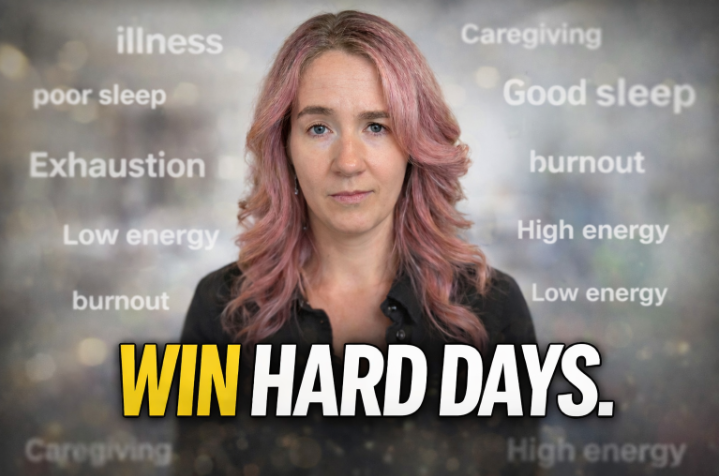
Superpower (high time, high bandwidth). Your calendar is clear and your brain is firing. This is when your most valuable, creative, strategic work happens. These windows are precious and they need to be protected.
Sprint (low time, high bandwidth). Your brain is fully online but you don’t have much runway. You can still do deep, high-value work — just in focused bursts. Don’t waste high bandwidth on low-value tasks just because the calendar is packed.
Sustain (high time, low bandwidth). This is the dangerous one, because it looks like opportunity. Your calendar is wide open and you feel like you should be crushing it. But your bandwidth is depleted. This is the quadrant most people misdiagnose as laziness or lack of discipline.
Survival (low time, low bandwidth). Triage only. Keep the lights on. Nothing creative, nothing complex, nothing that requires you to hold more than you already are.
The first shift is simply this: before you sit down to work, make the correct diagnosis. Which quadrant am I ACTUALLY in right now? Not which one do I wish I was in.
I have a pretty good example of what this looks like in real life.
A few years ago I got a call from my doctor: go to the ER immediately. Some tests had come back inconclusive, and the bad possibility was really bad. So I packed my laptop — because I knew I’d be waiting — and double-checked that I had my list of small, pre-decided tasks ready. My quick hits, just in case.
I got taken straight back, which if you’ve ever been to an ER, you know is not a great sign. And there I sat, laptop open, newsletter pulled up.
On paper? I had time. Two, maybe three hours of completely free time. No meetings, no interruptions. Classic high time, right?
But my brain was running constant threat simulations. Is this the bad thing or not? What happens to my business if it is? What do I tell my family? Those loops were consuming the exact same cognitive bandwidth I’d need to write a newsletter. I wasn’t in Superpower mode. I was deep in Sustain — high time, almost zero bandwidth.
Making that correct diagnosis saved me from staring at a blank screen for hours wondering what was wrong with me, and then being frustrated that I’d “wasted” all that time.
The action for Shift 1 is simple. Before you sit down to work, run a 30-second diagnosis. Two questions: How much uninterrupted time do I actually have? And what is running in the background right now — worry loops, poor sleep, unresolved situations, when I last ate or moved? These aren’t wellness questions. They’re bandwidth questions. Each one is a browser tab your brain has open.
Those two answers give you your quadrant. Here’s what to do with it:
- Superpower: Protect this window. This is for your most cognitively demanding work. Don’t fill it with admin. And take a second to notice what conditions created this state, because you’ll want to recreate it.
- Sprint: Your brain is fully online, so don’t waste it. Pick your single most important task and work in focused bursts.
- Sustain: You’ve just done the most important thing — you made the correct diagnosis. Don’t judge what you found. Your job right now is accurate awareness. Shift 2 tells you exactly what to do from here.
- Survival: Naming where you are is Shift 1 done. You are not lazy or broken — you are resource-constrained. Shift 2 has your next move.
Shift 2: Match the task to the bandwidth, not the clock
Now you have your diagnosis. So what do you actually do with it?
This is where cognitive load theory comes in, and it’s one of the most useful frameworks I’ve found for understanding why some days feel impossible even when the tasks look simple. Researchers found that working memory has a very limited capacity — when total cognitive load exceeds that capacity, performance drops sharply.
So when you’re in Sustain or Survival mode, those mental slots are almost full before you even open a document. The easy task isn’t landing in an empty inbox. It’s trying to squeeze into a full one. That’s why you reread the same sentence four times. That’s why you type something and immediately forget what you were about to say. That’s not a focus problem. That’s cognitive load doing exactly what the science predicts.
But here’s the part that should actually make you feel a little better. The research also shows that stress doesn’t uniformly kill all productivity. Simple, structured, pre-decided tasks can be maintained even under high cognitive load. It’s the complex, creative, strategic work that takes the hit.
Every quadrant has a task strategy. And the goal isn’t to push through — it’s to match.
Back in the ER, once I accepted I was in Sustain mode and not Superpower, the right move became obvious. I put the laptop away and went to my quick-hit list. Pre-decided, simple tasks. Things I didn’t have to think about — just execute. And that worked for a while. Sustain mode, Sustain tasks. It matched.
Then even that stopped working. My bandwidth had dropped further and I’d fallen into Survival. I just couldn’t stop thinking about how bad the worst case would be and what it would mean for me and everyone around me. So I closed everything and watched TV shows I’d downloaded.
That was the right call. Not lazy. Not giving up. The correct task for the correct quadrant.
The action for Shift 2 is to build a bandwidth-matched task list. You can keep them separate or simply tag items in your existing task manager so you can filter quickly when you need them. The key is to build these lists while you’re in Superpower or Sprint — not when you actually need them. If you’re in Sustain or Survival right now, keep reading. Your action item is coming.
- Your high-bandwidth list: strategy, writing, complex decisions, creative work. This only gets touched in Superpower or Sprint.
- Your low-bandwidth list: pre-decided, structured, mechanical tasks. Admin, inbox triage, simple execution. You don’t decide what goes on this list when you’re depleted — because deciding costs bandwidth you don’t have. You build it now.
One more thing: add rest explicitly to your Survival plan. What are the three non-negotiables that keep client relationships intact when everything else can wait? Know this before you need it. When you’re in Survival mode is not the time to figure it out.
Now, I want to make sure this doesn’t accidentally become permission to abandon your most important projects every time your bandwidth dips — because that’s not what this is.
Sustain mode doesn’t mean you can’t move meaningful work forward. It just means you probably shouldn’t finalize your website today if you can avoid it. What you can do is find some design directions you like. That one small thing moves the project forward and fits in the cognitive space you actually have.
I call this your MVP — Minimum Viable Progress. The smallest version of a task that still moves something that matters forward. Not admin instead of real work. Real work, sized down to fit your current bandwidth.
A couple of examples: instead of “work on the website for two hours” — find layouts or themes you like. Instead of “write the sales page” — write one headline option. That’s it. Done.
The rule for an MVP: one concrete, completable thing that requires no decisions and no holding of context. Small enough to fit in whatever cognitive space you have left. Still connected to something that matters.
Shift 3: Build the system before the crisis
Shifts 1 and 2 work beautifully when you have enough bandwidth to use them. But what about the seasons when you don’t? What about the weeks — or months — where low bandwidth isn’t a rough Tuesday afternoon, it’s your entire reality?
Here’s the hard truth: you cannot build bandwidth-aware systems from the bottom half of the grid. Sustain and Survival mode are not design environments. The thinking, the planning, the restructuring — all of that requires exactly the cognitive resources you don’t have when you’re depleted.
Research on self-regulation tells us that managing emotions, suppressing panic, staying composed — all of it is cognitively expensive. It draws on the same limited resources as your actual work. The difference is it doesn’t show up as output. So you look at a hard week, see nothing to show for it, and don’t account for all the invisible cognitive labor happening in the background.
This is why the system has to be built in Superpower or Sprint. Not because you’re planning for failure — because you’re building something resilient enough to survive a human life. And human lives include hard seasons.
The second chapter of my ER story is the one that actually matters.
It turned out not to be the worst case. I was enormously fortunate. But I did end up spending nearly a year recovering with two torn tendons, one in each elbow. I lost the ability to type for months. I was in constant pain and ran my business on voice-to-text, working reduced hours, operating in a body that was constantly sending distress signals.
For almost a year I lived in Sustain and Survival mode.
What saved me was a system I had already built before any of this happened. I had previously reduced my working hours, batched my most cognitively demanding work into protected windows, delegated tasks that didn’t require my specific brain, and built checklists for recurring processes so future-me wouldn’t have to reconstruct them from scratch every time.
I built all of that in Superpower mode. And it held the business together through a year of Sustain and Survival.
The action for Shift 3 is a system audit — three questions. Ideally in Superpower or Sprint, but there’s a version for every quadrant.
- What are my highest-bandwidth tasks, and when am I actually protecting time for them? Not hoping for time — scheduling it. Superpower windows need to be in the calendar before everything else fills it.
- What recurring tasks could become a checklist or template right now? Every time you redo a process without a system, you’re burning bandwidth that could have been eliminated.
- What is currently living only in my head? Anything that only exists in your memory is consuming working memory whether you’re actively thinking about it or not. Get it out of your head and into a system.
And one final question to sit with: if my bandwidth dropped by 50% tomorrow and stayed there for six months, what would break first? Because that’s the thing to build a system for today.
If you’re in Sustain right now, your job isn’t to build everything out — it’s to notice. When something feels like it should be systematized, capture that observation. A voice memo, a quick note, anything. Don’t lose the insight just because you can’t act on it yet. That note becomes your Superpower project later. If you’re in Survival, your only job is to get through it. If there’s a sliver of capacity, write down one thing: what do I wish I’d built before this? That’s your future Shift 3.
Shift 4: Ditch the guilt
I want to talk about a phrase I genuinely cannot stand.
“Everyone has the same 24 hours.”
The implication being that if you’re not maximally productive with every hour of your day, that’s a character flaw. A discipline problem. And now that you understand the 2×2, I want you to see exactly how wrong this is.
Two people can both have 24 hours. But if one of them is navigating a financial crisis, a health scare, caregiving for a sick family member, or just came out of three consecutive nights of poor sleep — they do not have the same usable hours. They have the same clock. They do not have the same bandwidth.
Researchers actually quantified this: when they made financial stress cognitively present — just by asking people to think about a financial problem before a cognitive test — performance dropped in ways comparable to losing IQ points. Not because those people got less intelligent. Because bandwidth was consumed by worry before they even started.
Telling someone in Sustain or Survival mode that they have the same 24 hours is like telling someone whose laptop has 47 tabs open that they have the same processor. Technically true. Completely useless information.
But here’s where it gets really important. The response most of us have to a low-output day isn’t neutral. It’s guilt. And guilt is not a neutral experience — it runs as a background process. It is a browser tab. It eats the same cognitive bandwidth you’re already short on.
When you pile guilt on top of a depleted state, you are not motivating yourself to do better tomorrow. You are measurably reducing your capacity to perform tomorrow. You’re taking a difficult state and making it worse instead of climbing back up the quadrant grid.
The science on reduced output during high-stress, low-bandwidth periods is not a moral failure. It is a predictable brain response to a measurable resource constraint. Accepting that — truly accepting it — is what frees up the bandwidth you were burning on self-recrimination and redirects it toward what’s actually possible right now.
Being kind to yourself in low-bandwidth moments is not soft. It’s the scientifically sound performance strategy.
Let me finish the ER story.
I put the laptop away. I watched TV. I stopped fighting the diagnosis. And then I got the news — it wasn’t the worst case. I was going to be okay.
Something shifted. Not the room. Not the time. Same person, same chair. The background processes stopped running. The threat simulations went quiet. The bandwidth came back. I opened the newsletter and wrote the whole thing.
Same day. Actually less time remaining. Completely different bandwidth. And zero guilt about the hours that came before — because I’d made the correct diagnosis, matched the correct tasks to the correct quadrant, and let the bandwidth restore itself instead of burning what little remained on shame.
That’s what this framework is actually for.
The action for Shift 4 is probably the hardest one, because it’s not a system you can tag in your task manager. It’s a reframe. And reframes take practice.
When you have a low-output day, the default is to interrogate yourself: why couldn’t I do more? What’s wrong with me? Replace that with a diagnosis: what quadrant was I in today? Was my output actually appropriate for that quadrant? What do I need tonight so that tomorrow I start with slightly more bandwidth?
That’s not letting yourself off the hook. That’s using accurate information to make a better decision. And it will produce better output tomorrow than the guilt spiral will, every single time.
One practical tool that helps: keep a bandwidth log. A quick note at the end of the day — which quadrant you were in, what you worked on, how it felt. Over time you’ll start to see your own patterns. Your natural Superpower windows. Your bandwidth drains. Your recovery triggers. That data becomes the foundation for building a business that actually works with your brain.
The bottom line
Time and bandwidth are not the same resource. They don’t move together. And until you’re diagnosing both, you’re making task decisions based on half the picture.
So here’s the question to sit with: not “why couldn’t I be more productive during that hard stretch” — but “what would my business need to look like so that a low-bandwidth period doesn’t crater everything?” Because that’s a buildable thing. Superpower windows protected in the calendar. A pre-made low-bandwidth task list. MVPs for your important projects on hard days. A Survival plan that exists before you need it.
You’re not trying to be productive at all costs. You’re trying to build something that works with your brain across the full range of what a human life actually looks like — good days and hard ones.
That’s the goal. And now you have the science to back up why it matters.
I’ve built a free bandwidth check-in tool here that walks you through the diagnosis and task-matching process in just a few minutes — and it includes all four quadrant action cards from today.
Which quadrant do you spend the most time misdiagnosing? Drop it in the comments — I read every single one. 👇
If you found this helpful, sign up for our newsletter here to get more content like this delivered straight to your inbox.
Sources
1. Shields, G.S., Sazma, M.A., & Yonelinas, A.P. (2016). The effects of acute stress on core executive functions: A meta-analysis and comparison with cortisol. Neuroscience & Biobehavioral Reviews, 68, 651–668.https://doi.org/10.1016/j.neubiorev.2016.06.038
2. Sweller, J. (1988). Cognitive load during problem solving: Effects on learning. Cognitive Science, 12(2), 257–285.https://doi.org/10.1207/s15516709cog1202_4
3. Mani, A., Mullainathan, S., Shafir, E., & Zhao, J. (2013). Poverty impedes cognitive function. Science, 341(6149), 976–980.https://doi.org/10.1126/science.1238041
4. Koay, J.M., & Van Meter, A. (2023). The effect of emotion regulation on executive function. Journal of Cognitive Psychology, 35(3), 315–329.https://doi.org/10.1080/20445911.2023.2172417
5. Cavalera, C., Pepe, A., Zurloni, V., Diana, B., Realdon, O., Todisco, P., Castelnuovo, G., Molinari, E., & Pagnini, F. (2018). Negative social emotions and cognition: Shame, guilt and working memory impairments. Acta psychologica, 188, 9-15 . https://doi.org/10.1016/j.actpsy.2018.05.005.