Science Says
The 8-Hour Sleep Myth (And What To Do Instead)

Transcript:
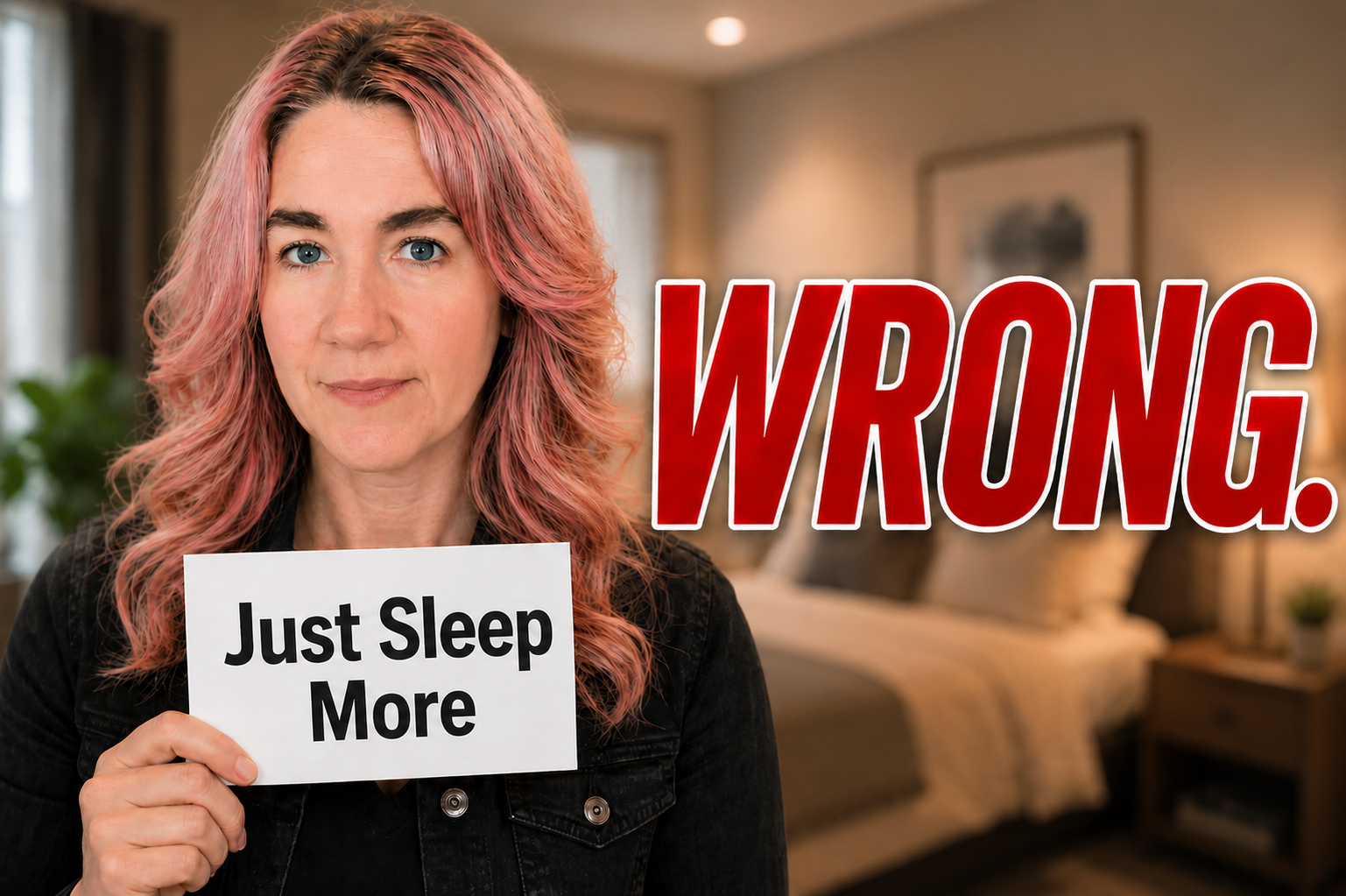
Just sleep more. You’ve heard it, right? You already know sleep is important. You’ve heard it a thousand times. So you set the goal, “I’m gonna sleep more, eight hours,” and then you either can’t hit it and feel like you’re failing, or you hit it and you still feel exhausted. Somehow, both of these things are your fault.
Here’s the thing nobody’s talking about. You might be chasing the wrong number entirely, and if that’s true, no amount of discipline or earlier bedtimes is gonna fix it. You’re just optimizing for someone else’s biology.
By the end of this post, you’ll have answered five questions I call the Sleep Fingerprint. It’s a diagnostic that tells you whether the sleep advice you’ve been following actually applies to you. One question per section. You can answer each one right now as we go.
Because I dealt with insomnia from 2006, took all the things, including Ambien, and the fix that finally worked wasn’t a supplement or a routine someone else gave me. It was figuring out I’d been asking the wrong questions the whole time.
A Quick Note Before We Get Into This
Nothing in this post is medical advice. I’m sure you saw that coming. I’m not a doctor. If you’ve been struggling with sleep for a long time, or you suspect something like sleep apnea, please talk to a doctor or a sleep specialist.
The questions I’m about to walk you through are a starting point for self-awareness, not a replacement for medical care. They worked for me alongside actually getting diagnosed and going through the medical system. Both can be true, and if anything, you’ll just have more data to bring to your doctor.
Oh, and I built a free tool you can grab here that will walk you through all of the questions. But the why behind the questions is really key, so I’d encourage you to stay with me if you have just a few minutes.
The Average Problem
Eight hours does come from real research. Large population studies suggest a U-shaped curve where around seven to eight hours of sleep is associated with the best cognitive outcomes, with performance dropping off when people routinely sleep much less or much more.
There’s actually a study of nearly half a million adults that found peak cognitive performance right around seven hours, with results dropping off on both sides. So too little AND too much.
But here’s what that finding actually tells you. It tells you where the average sits. It doesn’t tell you exactly where you land on that curve. There are meaningful differences in sleep need between individuals, and that’s the part a lot of sleep advice skips right over.
This is the problem with hearing the word “average” and treating it like “probably.” I made a whole video on habits where I mention the average number of days to build a habit is 66, but that the actual range is 18 to 250 days. That’s a massive spread hiding behind a tidy little average number.
Sleep is the same kind of problem when it comes to practical application. What matters is what’s true for YOU, not the population average. To be fair, the range is not quite that wide for sleep.
Question 1: Do You Wake Up Rested?
In a low-stress period when you’ve had what felt like enough sleep, most people tend to wake up feeling rested. If you consistently don’t, that’s data. So either eight hours isn’t your number or something else is interfering with how restorative those hours actually are.
This was me starting in 2006. I went through a really difficult personal event in grad school that just obliterated my sleep. After that, it was kind of a flywheel. The worse I slept, the more anxious I got about sleeping, and the worse I slept. I worked with doctors, tried supplements, tried prescription medications.
And again, to be clear, that medical care mattered. At one point, I had been awake for almost forty-eight hours straight. I did sleep two hours somewhere in there. It was awful. Prescription medication was what got me sleeping again. It didn’t make me feel particularly rested, but it sure as hell was better than where I’d been before.
I just felt like there had to be a better option than being on something long term and never quite feeling rested. And I figured even if I tried everything and ended up needing medication anyway, at a minimum, I’d have a lot of experiment data to take to a doctor and get more targeted help. So that’s what I started doing.
I want to be really clear because not everybody’s path looks the same. I was fortunate. I ended up able to come off of all of the sleep medication, supplements, everything, and actually feel truly rested. That’s the outcome I personally got. Not everybody will end up there, and that’s not a failure. Some people are gonna do all this work and still need medication long term, and that’s a completely valid outcome too.
This isn’t an anti-medication post. The goal is to actually feel rested however you get there, and have a sustainable system for sleep, whatever that looks like for you.
Question 1: In a genuinely low-stress period, when you’ve slept what felt like enough, do you wake up rested? One word. Yes, no, or sometimes. Write it down. If you have a piece of paper handy, that would be great.
Question 2: Is Your Sleep Timing Consistent?
Here’s a finding that genuinely surprised me when it comes to what matters in sleep. In a study of about 60,000 adults, higher sleep regularity was associated with substantially lower risk of death from any cause, and it predicted mortality risk more strongly than average sleep duration.
Consistent timing beat hitting a magic number.
That one hit me, because I’ve been doing the opposite. I’m my own boss, so if I went to bed late or didn’t sleep well, I’d just sleep in to make up the extra hours. It felt logical, right? Eight hours, get the eight hours. The research taught me that I wasn’t actually doing myself any favors long term.
Going to bed and waking up at roughly the same time, including on weekends, matters more than most people realize. So I tested it on myself. I started waking up at the same time every single day, weekends included, even when it felt unnatural. By nature, I wouldn’t typically feel tired until 10:30 or 11 PM on a good night, closer to midnight if I followed what really felt natural.
But once I committed to a consistent wake-up time and really stuck with it, my body actually started getting tired around 8 PM, which is crazy. And that’s when my “go to bed” alarm would go off. That shift took weeks. I had to actively engineer it, which meant changing my evenings, my weekends, the kind of content I consumed before bed, who I spent time with.
I made a whole separate video about how to use environment design to shift habits like that.
Question 2: Is your wake-up time roughly consistent across days, including weekends?
Honest answers. If your weekend wake-up is more than an hour different from your weekday wake-up, regularity might be a bigger lever for you than duration.
Question 3: What’s Your Relationship With Your Bed?
This one matters a lot. Your bed is either a cue for sleep or a cue for wakefulness, and your brain learns which one based on what’s actually happening there.
There’s a gold-standard treatment for chronic insomnia called cognitive behavioral therapy for insomnia, or CBT-I, and one of its core behavioral tools is something called stimulus control. The rule is simple. If you’ve been in bed for a while and you’re just not getting to sleep, especially if you’re getting frustrated, just get out of bed, go somewhere else, do something quiet in low light, come back only when you’re sleepy.
The idea is you’re retraining your brain so bed equals sleep again, not “that place where I lie awake and stress.” If bed feels like a dread zone, stimulus control is one of the most evidence-backed behavioral starting points for chronic insomnia.
And if your insomnia is severe or has been going on for years, a doctor or sleep specialist trained in CBT-I can guide you through this in a structured way.
I’ll be honest, that’s actually not the path I took. The medical doctors I saw mostly gave me drugs and told me, “Be less stressed,” which was about as helpful as you would expect. So I went, I read the research on stimulus control, and once I understood what it was trying to do, basically change the “bed as stressor” pattern, I wondered if the opposite approach might work for my specific situation.
Going to bed had already become a really stressful event, so I gave myself a ridiculously long time in bed, way more than eight hours. The logic was: if I have plenty of time, I don’t need to rush. And remember, I was already stressed out thinking “I need to hurry up and fall asleep.” So I figured even if I lay there calmly for an hour and don’t sleep, that’s still an hour of calm rest rather than stimulation.
The pressure came off. I started falling asleep faster. I also discovered through tracking that I needed about nine hours of dark time in bed to actually get seven and a half hours of sleep. That ratio is just MINE.
I’m not telling you to copy this. It was a specific experiment based on my situation and my hypothesis, and it’s not the standard protocol, which is the whole point. Before you try things, get a rough sense of which problem you actually have. The fix for “bed feels like dread” and the fix for “I just need more time to wind down” would be totally different.
Question 3: When you get in bed at night, what do you feel? Relief, neutrality, or some version of dread?
If your answer is dread, stimulus control is your evidence-backed starting point. If it’s neutral or relief but you’re still exhausted, something else is the main lever, and questions 1, 2, and 4 might have it for you.
Question 4: When Do You Actually Function Best?
Chronotype, whether you’re a morning or evening person, has real biological basis. Research on chronotype and “social jet lag” shows that when your sleep schedule is misaligned with your internal body clock, you could feel foggy and underperform even if your total sleep time looks normal on paper.
A note on waking up in the middle of the night, since this comes up a lot. Brief awakenings during the night are a normal part of sleep. Healthy adults show multiple short arousals on sleep studies, and most don’t reach full awareness or even get remembered the next day.
What matters is what happens after you wake. If you fall right back to sleep, that’s the system working as designed. If you’re awake for an hour, or you reach for that good old phone, or you just can’t get back to sleep, that’s a different problem. A lot of the time, the difference between “I slept great” and “I slept terribly” isn’t about the arousal itself, it’s about whether something kept you awake afterwards.
For me, the chronotype work and the regularity work kind of happened together. Once I locked in a consistent wake-up time and gave my body the signal that we were doing this every day, my chronotype actually shifted earlier over time. I’m not saying chronotype is easy to change. I think mine is probably still night owl.
The biology is real, but “I’m a night owl” doesn’t have to be a permanent ceiling, especially if you’re willing to work the regularity lever first.
Question 4: When do you actually feel sharpest? Not when you have to. When do you naturally? If it’s 10 PM, the sleep advice designed for morning types may not translate directly for you, and if you want to shift it, regularity is probably your starting point.
And I’m not gonna lie, it’s a lot of work if you’re gonna do something that’s going against your biology.
Question 5: What Have You Already Tried?
A lot of the big sleep guidelines lean heavily on large population studies that use self-reported sleep. They’re great rough markers, but they can’t account for you specifically. Your own data is valid evidence.
And one thing specifically worth tracking is alcohol. Even small amounts of alcohol in the evening tend to disrupt sleep architecture, particularly REM sleep, even though alcohol is widely used as a sleep aid. It helps you get to sleep faster, but disrupts your sleep.
I also cut out sugar and alcohol completely at a certain point, and when they came back, even one drink in the late afternoon or evening worsened my sleep. ONE drink. That’s true for me. Again, I only know it because I tracked it.
Same with light. General advice says avoid screens, but my Kindle at the lowest setting doesn’t affect my sleep at all. My phone does. Even on the black and white mode, no matter what mode, it affects it. But you’d never know that without running the experiment on yourself.
Back to my caveat again. If you suspect an actual sleep disorder like apnea, chronic severe insomnia, et cetera, your experiments are just a starting point, not a substitute for talking to a doctor. I can’t say that enough. The Sleep Fingerprint can tell you whether standard sleep advice is the right advice for you, but it can’t tell you whether something medical is going on underneath. That’s a different conversation, and one worth having with that medical professional.
Question 5: What have you already changed, and what actually moved the needle toward more restful, better sleep?
If you’ve never tracked anything, pick one variable and track it for two weeks. Not 10 things. One. You are the scientist and the data.
Your Sleep Fingerprint
Five questions. That’s your Sleep Fingerprint. The eight-hour rule isn’t wrong for the average person. It’s just not a prescription, and you are not the average. Or maybe you are, but you won’t know until you track.
Drop your answer to question 3 in the comments. What’s your actual relationship with your bed right now? I read every single one.
And don’t forget to download the free guide here.
If you found this helpful, sign up for our newsletter here to get more content like this delivered straight to your inbox.
Sources
- Tai, X. Y., Chen, C., Manohar, S., & Husain, M. (2022). Impact of sleep duration on executive function and brain structure. Communications Biology, 5(1), 201. https://doi.org/10.1038/s42003-022-03123-3
- Windred, D. P., Burns, A. C., Lane, J. M., Saxena, R., Rutter, M. K., Cain, S. W., & Phillips, A. J. K. (2024). Sleep regularity is a stronger predictor of mortality risk than sleep duration: A prospective cohort study. Sleep, 47(1), zsad253. https://doi.org/10.1093/sleep/zsad253
- Edinger, J. D., Arnedt, J. T., Bertisch, S. M., Carney, C. E., Harrington, J. J., Lichstein, K. L., Sateia, M. J., Troxel, W. M., Zhou, E. S., Kazmi, U., Heald, J. L., & Martin, J. L. (2021). Behavioral and psychological treatments for chronic insomnia disorder in adults: an American Academy of Sleep Medicine clinical practice guideline. Journal of Clinical Sleep Medicine, 17(2), 255–262. https://doi.org/10.5664/jcsm.8986
- Furukawa, Y., Sakata, M., Yamamoto, R., Nakajima, S., Kikuchi, S., Inoue, M., Ito, M., Noma, H., Takashina, H. N., Funada, S., Ostinelli, E. G., Furukawa, T. A., Efthimiou, O., & Perlis, M. (2024). Components and delivery formats of cognitive behavioral therapy for chronic insomnia in adults: A systematic review and component network meta-analysis. JAMA Psychiatry, 81(4), 357–365. https://doi.org/10.1001/jamapsychiatry.2023.5060
- Taillard, J., Sagaspe, P., Philip, P., & Bioulac, S. (2021). Sleep timing, chronotype and social jetlag: Impact on cognitive abilities and psychiatric disorders. Biochemical Pharmacology, 191, 114438. https://doi.org/10.1016/j.bcp.2021.114438
- Della Monica, C., Johnsen, S., Atzori, G., Groeger, J. A., & Dijk, D.-J. (2018). Rapid eye movement sleep, sleep continuity and slow wave sleep as predictors of cognition, mood, and subjective sleep quality in healthy men and women, aged 20–84 years. Frontiers in Psychiatry, 9, 255. https://doi.org/10.3389/fpsyt.2018.00255
- Gardiner, C., Weakley, J., Burke, L. M., Roach, G. D., Sargent, C., Maniar, N., Huynh, M., Miller, D. J., Townshend, A., & Halson, S. L. (2025). The effect of alcohol on subsequent sleep in healthy adults: A systematic review and meta-analysis. Sleep Medicine Reviews, 80, 102030. https://doi.org/10.1016/j.smrv.2024.102030