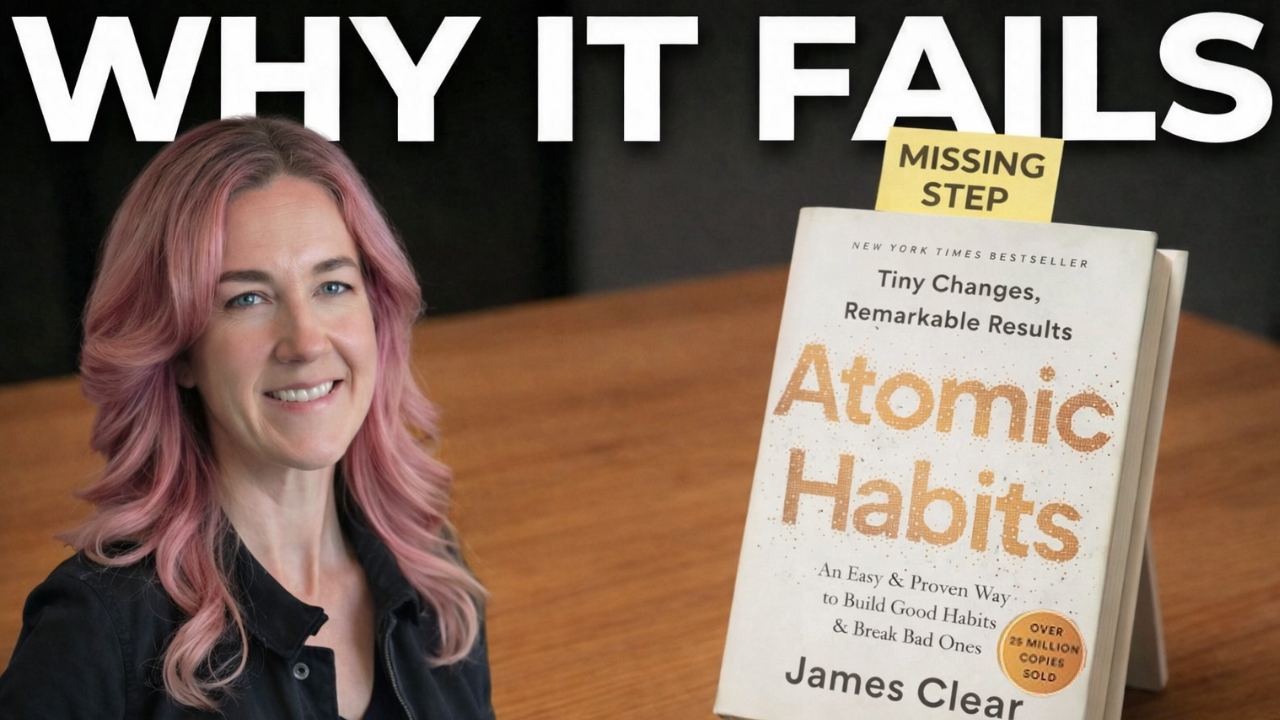
You’ve probably tried habit stacking before. The classic idea of, “After I brew my coffee, I’ll do X.”
I did that too. I stacked my physical therapy exercises onto my Nespresso routine, and I did them every single day for years. But the second I traveled? That habit disappeared. It just… evaporated. No Nespresso machine, no physical therapy.
Meanwhile, that same morning coffee routine? I once had to put a Post-it note on my coffee machine to stop myself from brewing it before fasting blood work, because I would do it on pure autopilot. I knew from experience — because the last time, even though I was not waking up at the same time of day and had a totally different morning routine to make it to the place on time, I still hit that brew button first thing. I was halfway through my cup of coffee when I remembered I wasn’t supposed to be drinking it.
Same brain. Both situations had cue disruptions. Two completely different results.
And this is where a lot of habit advice — including Atomic Habits — quietly breaks down. Not because the book is wrong. It’s incredibly useful. But because it doesn’t really spell out one big piece of habit science.
Two Types of Habits: Natural vs. Engineered
Your brain doesn’t rely on just one habit system. It uses two overlapping systems to control behavior. This is a simplified model, but neuroscientists do talk about both goal-directed and habit systems that can share and shift control over time.
The goal-directed system is your thinking system. It’s flexible, deliberate, and great for learning new behaviors — but it’s also energy-hungry, and it gets tired easily.
The habit system, on the other hand, runs on autopilot. It executes routines efficiently with very little conscious effort. With repetition, neural control can gradually shift so behaviors run with less conscious oversight.
But here’s the key point: not all habits ever make that shift.
So let’s use a simple distinction — what I’ll call natural habits versus engineered habits. This is a conceptual framework, not official scientific jargon, but it maps closely onto how habits behave in everyday life.
Natural habits are usually learned and reinforced over long periods, often beginning in childhood or adolescence. They’re closely tied to identity, triggered by multiple cues, and automatic across much of daily life — especially in familiar environments.
Engineered habits — which is what most habit advice teaches — are deliberately constructed. They’re often tied to one primary cue, more consciously maintained, strongly context-dependent, and more likely to weaken when routines shift.
When we confuse these two, people start thinking they’re bad at habits, when they’re actually just working with the wrong expectations. Advice like put your workout clothes out so you put them on and go to the gym or don’t buy unhealthy snacks so you don’t eat them is great advice… until you’re just too tired to set your workout clothes out, or you forgot to do laundry.
What “Natural” Really Means
Just recently I was chatting with a friend who naturally eats balanced meals — protein and vegetables — without tracking anything. She barely thinks about it. I didn’t grow up eating like that. Not at all. My healthy eating routines were learned through research, trial and error, and months going on years of deliberate effort.
But because she sees me eating healthy, she assumed it was the same for both of us. During that conversation, she suddenly realized something important: her partner’s defaults were totally different from hers. Not because he was undisciplined, but because his habits were built differently.
What feels intuitive to one person is often just a deeply reinforced habit from early life. And what feels hard to someone else may simply be a behavior that was engineered later and never became deeply automatic.
Some people might look like they are executing natural habits… when really, they’re putting forth effort every day to do that thing. Meanwhile, people might look at you wondering how you have so much self-discipline, when really, it’s just natural. We tend to undervalue what we don’t work for — so it makes sense that we don’t pat ourselves on the back for these “natural” habits and sometimes miss them altogether. After all, maybe we have just always done it.
Why Context Is Everything
Going back to my physical therapy habit: when I traveled, the habit disappeared. Because many deliberately built habits either never fully move onto autopilot, or take far longer than people expect. No Nespresso machine — and without the cue, the habit struggles to fire.
A habit isn’t just something you do a lot. It’s a context–response association. Research shows that your brain links a cue — like a place, a time, or a sensory signal — to a behavior. When the cue appears, the habitual behavior tends to fire automatically. When the cue disappears, you’re much less likely to do the behavior unless you consciously decide to.
This also explains why the 21-day or 30-day habit myth doesn’t hold up. The average time to habit automaticity is around 66 days — but the range is huge, anywhere from about 18 days to more than 250 days (that’s almost a year), depending on the behavior. And some behaviors never become highly automatic at all. They remain partly deliberate, even with long-term repetition.
Most importantly, habits fire most automatically in the context they were formed in. Change the context — like travel, a new job, or a new schedule — and habit performance often drops fast.
Where Atomic Habits Fits In
James Clear’s strategies are evidence-based and can be very effective: habit stacking, environment design, identity framing, making habits obvious and easy. But here’s the missing clarification — engineered habits are strongly context-dependent. They often don’t automatically generalize to new environments. That’s not a flaw in the method. It’s just how habit systems work.
What To Do With This
Stop expecting every habit to become natural. Some never become fully automatic, and that’s okay.
Identify which of your habits are engineered. Those habits need more support and maintenance. Expect to spend energy on them — and keep spending energy.
When your routine changes, just rebuild the cue. Use time-based triggers. Use digital reminders. Recreate a small version of the cue in new environments.
Build redundancy. Natural habits usually have multiple triggers. Engineered habits shouldn’t rely on just one.
Normalize drop-offs. A broken engineered habit isn’t proof of laziness or that something didn’t “work.” It’s strong evidence that your cue vanished — not that your character failed.
You’re not bad at habits. You’re not inconsistent. You’re not lacking discipline. You’re just expecting engineered habits to behave like natural ones — and the science shows they often don’t.
I’ve built a Habit Decoder to help you identify your natural and engineered habits — you can access it here.