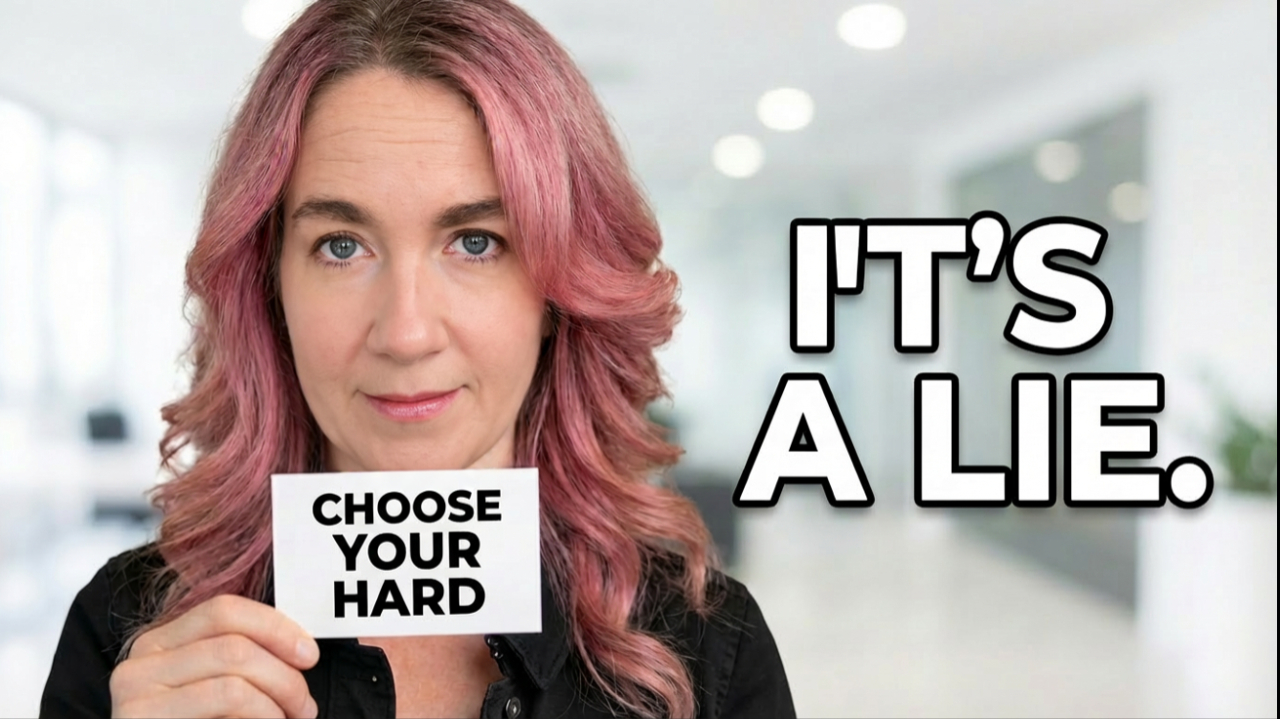
Science Says
“Choose Your Hard” Is Making You Worse at Hard Things

Transcript:
I used to live by this phrase. I was right there with the “choose your hard” crowd — nodding along, sharing the posts, feeling genuinely pumped up. I get why it resonates. It sounds like accountability. It sounds like ownership. It sounds like control.
But here’s where it fell apart for me.
I’ve been coaching freelancers and small business owners for over 10 years, helping them improve their productivity and businesses. In that time, I’ve coached people going through family trauma, serious illness, mental health crises, chronic insomnia — some of the hardest seasons a person can go through. I could never bring myself to look someone in those circumstances in the eye and tell them to just choose their hard. It never felt right. It never felt true.
And honestly, before any of that, I had my own hard season that left me with truly no choice but to figure out a completely different way to work. One that didn’t rely on just pushing through — because pushing through simply wasn’t available to me anymore. That’s a story for another time.
But I went looking for the science. I wanted to know: was my gut reaction right, or just a gut reaction? Was this advice missing something important?
What I found changed how I think about behavior change entirely.
The Real Engine Behind Your Behavior
Most behavior isn’t driven by willpower. It’s driven by what feels normal in your environment. And there’s a very big difference between those two things.
Here’s what “choose your hard” gets wrong: it’s not exactly false. Hard things are hard. Showing up matters. I’m not arguing with that. What it misdiagnoses is the mechanism. It assumes that behavior is mostly a deliberate, conscious decision — that if you just summon enough willpower, you’ll override whatever is pulling you in the other direction.
But there’s a substantial body of research in social psychology on what’s called the automaticity of social life. The idea that a huge amount of our daily behavior runs on autopilot — triggered by the environment and the people around us, often without conscious intention. We copy what the people around us are doing. We follow situational scripts. We match the defaults of our environment. And we do it automatically, without realizing it’s happening.
So when “choose your hard” tells you to muscle through, it’s asking you to override a system that is often far more powerful than conscious effort.
There’s a second assumption built into “choose your hard” that bothers me even more than the willpower problem: it assumes both options are sitting equally in front of you. That Hard A and Hard B are real, available choices. For a lot of people going through a health crisis, a family trauma, a mental health struggle, a season of insomnia — that’s just not the case. One of those “hards” isn’t a choice at all. It’s just their life.
And that’s where it starts to feel like a moral issue rather than practical advice. If you believe it’s all about choosing, then not choosing becomes a character flaw. You’re not struggling because your environment is working against you. You’re just weak.
That’s not what the science says. And it’s not a helpful story to be telling yourself.
Choose Your Normal Instead
So if willpower isn’t the main engine, what is? Social norms.
Researchers draw a distinction between two types. Descriptive norms are what people around you actually do — the behaviors that are just normal in your environment. Injunctive norms are what people around you expect, what gets approved of and what gets side-eyed. Both quietly shape your behavior whether you consciously signed up for them or not.
Think about it this way: if everyone in your professional circle says you need to be the first to reply or you’ll lose clients — and they’re constantly hitting refresh on email during dinner with their families — that becomes the descriptive norm. It becomes the truth. Even if you disagree, resisting that every single day takes real energy.
On the flip side, if you’re in a community where people openly talk about client boundaries, where logging off at 5 p.m. is just what people do, then doing those things suddenly doesn’t feel like discipline. It just feels like fitting in.
Modeling research shows that norms can shift relatively quickly once enough people in a group start behaving differently. But here’s the flip side: norms that most people privately dislike can persist for a long time because nobody wants to be the first to break them. Hustle culture norms can keep running in your environment long after most people are quietly exhausted by them. And choosing your hard every day in that environment isn’t strength. It’s swimming upstream in a current that somebody else set.
Your Admired Peers Shape You Too
A 2022 study on peer influence found something worth sitting with: it’s not just your close friends who shift your defaults. It’s also your admired peers — the people you look up to, whose behavior you pay attention to. Over time, we genuinely drift toward the defaults of the people we spend time with and admire: their work hours, their spending habits, what they treat as a normal amount of effort.
Here’s what this looked like for me.
For years, I tried to become an early morning person. I set my alarm for 6 a.m. I lasted maybe a month at a stretch, every single time. I kept choosing my hard — and I kept sliding back, feeling like I just wasn’t built for it.
Fast forward to now: I’m up at 5 or 5:30 most mornings. Not because I found superhuman discipline. It’s because I stopped brute-forcing it and started asking a different question: how do I make this feel normal?
Here’s what actually changed. I scheduled early morning climbing and hiking on weekends — the times I was most likely to make late-night plans — so I was hanging out with early risers while still keeping my social life. I asked my husband to shift our dates earlier or do day dates. I changed what I consumed when I woke up: no Netflix, only content that made me feel like the version of myself I was building.
I wasn’t trying harder. I was redesigning what normal meant — and surrounding myself, in person and in the content I consumed, with people for whom this was already their default.
The Feed Problem Nobody Talks About
Here’s the sneakiest piece of all this: your social media feed.
A large-scale field experiment during the 2020 US election found that changing a feed’s structure changed what people were exposed to and how long they stayed on platforms — even though core attitudes were slower to shift. Your feed is constantly showing you what “everyone” is doing. And that shapes your sense of the norm, often without you realizing it.
If your algorithm has decided you like hustle content, it’s going to keep serving you 4 a.m. wakeups, 12-hour workday highlights, and “I outworked everyone” energy. Over time, that becomes your baseline for what a productive person looks like. Your casual scroll is a norm training session you didn’t sign up for.
I’m not saying your feed is brainwashing you — we have more agency than that. Core beliefs change slowly. But you don’t need your beliefs to change overnight for your behavior to start shifting. If your feed keeps showing you people treating unsustainable productivity as normal, the friction of doing things differently gets a little higher every day.
And here’s something the research doesn’t always spell out: there’s a difference between curating your feed toward sustainable productivity content and using it to build someone else’s highlight reel. Those are two very different things. If you unfollow the 4 a.m. hustle crowd and then fill your feed with people who seem to have it all perfectly figured out or who went viral on their first post — you’ve just traded one flavor of why can’t I be like that for another.
The goal is content that shows you realistic versions of the thing you’re building. Real people talking about what actually works, what doesn’t, and what it looks like on a Tuesday when things are a little bit of a mess.
Three Levers You Can Actually Pull
The research points to three levers for changing what feels normal to you — and none of them require more willpower.
Lever 1: Your People. Audit your top five work peers and your top five personal contacts. What are their defaults — work hours, availability, boundaries, rest, mindset? Are those the defaults you’d choose for yourself intentionally? If not, it’s worth being intentional about finding communities where the behavior you’re building is already the norm — where it would feel weird not to do it.
Lever 2: Your Explicit Norms. Most of us are operating on implicit norms we never chose. I should respond to clients within an hour. People in my field just work weekends. Nobody wrote these down. Nobody agreed to them. But they’re running the show. Research on norm change shows that making norms explicit — writing them down, stating them out loud, sharing them with clients, collaborators, friends, and family — is one of the most effective behavior change levers available. Write down three norms you want to be true in your business and your life. Then ask honestly: does your current environment actually support them?
Lever 3: Your Feeds. Do a five-minute audit. What does your average scroll teach you is normal for someone in your professional or personal life? Is that the normal you want? Unfollow, mute, and use the “not interested” button aggressively. Curate toward creators who model realistic, sustainable productivity — not perfection, not toxic positivity, not “I built an AI agent that made me millions overnight.” Honesty. Balanced views. Real results.
Change the people, the norms, the content — and you change what your brain’s autopilot treats as the default. That’s not taking the easy road. That’s being strategic about the environment your habits have to live inside.
Wrap Up
“Choose your hard” isn’t malicious advice. Hard things are hard, showing up matters, and we do need to do hard things — often. But if you’ve been white-knuckling something for months and it just keeps not sticking, the problem probably isn’t your character. It’s that your environment keeps voting against you. And no amount of willpower is going to win that fight long-term.
You don’t just get to choose your hard. You get to choose your normal. And that’s a much more powerful game.
I built a tool to help you do exactly this — the link is here. And let me know in the comments: if you could wave a magic wand, what would your normal feel like?
If you found this helpful, sign up for the newsletter here to get more content like this delivered straight to your inbox.
Sources & References
Bargh, J. A., & Williams, L. E. (2006). The automaticity of social life. Current Directions in Psychological Science, 15(1), 1–4. https://doi.org/10.1111/j.1467-8721.2006.00395.x
Tankard, M. E., & Paluck, E. L. (2016). Norm perception as a vehicle for social change. Social Issues and Policy Review, 10(1), 181–211. https://doi.org/10.1111/sipr.12022
Shin, H. (2022). Social contagion of academic behavior: Comparing social networks of close friends and admired peers. PLOS ONE, 17(3), e0265385. https://doi.org/10.1371/journal.pone.0265385
Guess, A. M., Malhotra, N., Pan, J., et al. (2023). How do social media feed algorithms affect attitudes and behavior in an election campaign? Science, 381(6656), 398–404. https://doi.org/10.1126/science.abp9364